
You spend fifteen minutes drafting a prompt. You describe the exact tone, outline every constraint, specify the passive-aggressive politeness level of a customer support email, and hit enter.
The output lands. It feels completely off.
I used to fix this by adding another paragraph of instructions. I would write tighter adjectives, stack more rules, and plead with the model to sound natural. Invariably, the response got stiffer, weirder, and further away from what I actually envisioned.
Here is the hard truth about modern large language models: they are world-class pattern-matching engines, but mediocre rule-followers when those rules become abstract essays.
When you replace three paragraphs of rules with two concrete examples, the model immediately locks onto your frequency. In technical literature, this is known as few-shot learning, and it is the single most reliable way to get consistent work out of an AI.
The Abstract Rule Trap
When we talk to other humans, we rely on shared social context. If I tell a colleague, "Make this sound professional but not stuffy," they draw upon years of human workplace intuition to know what that balance feels like.
When you say that to a neural network, "professional" triggers statistical associations with corporate jargon, passive voice, and boilerplate disclosures. "Not stuffy" triggers a competing cluster of casual slang. The model tries to sit between both vectors, producing a strange hybrid that satisfies neither.
This is why your AI writing sounds like a robotic HR memo even when you explicitly demanded a conversational voice.
Large language models process text through token probabilities. Every rule you write adds competing attentional demands. Instead of learning your goal, the model tries to mathematically balance twenty competing instructions simultaneously.
This friction is closely tied to why telling AI what not to do fails. When you flood the context window with prescriptive boundaries, the model spends its processing power parsing your negative commands rather than executing the core transformation.
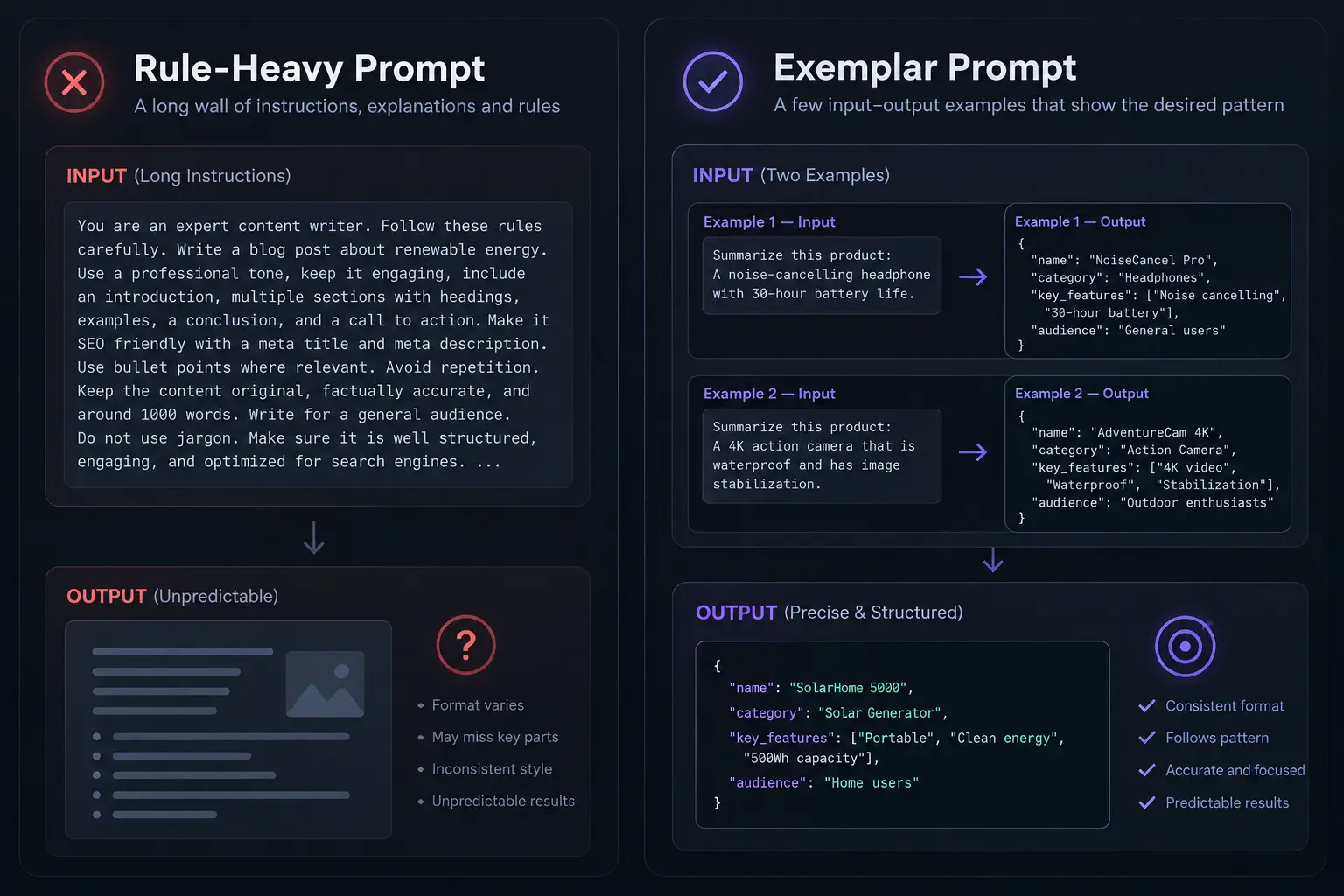 Why Giving AI Examples Beats Long Explanations
How In-Context Learning Actually Works
Models do not memorize rules the way a programmer reads syntax. Instead, they leverage in-context learning to detect structural rhythms, phrasing cadences, and latent criteria directly inside the conversation window.
When you supply an input alongside its ideal output, the attention mechanism calculates the implicit transformation function.
As computer scientist and AI researcher Andrej Karpathy once observed, English is becoming the hottest new programming language—not because models understand semantic intent like humans, but because tokens act as steering weights for statistical generation.
Consider the difference in approach when generating executive updates:
| Attribute | Descriptive Rule Prompt | Few-Shot Example Prompt |
|---|---|---|
| Cognitive Load on Model | High (must balance competing adjectives) | Low (matches existing patterns) |
| Format Consistency | Low (frequently drifts across runs) | Very High (mirrors provided syntax) |
| Punctuation & Tone | Stiff or artificial | Natural and contextual |
| Prompt Length | Bloated with negative rules | Compact and modular |
This is why your teammate's AI output looks better than yours despite them writing half as much text in their prompt. They aren't explaining what they want; they are showing what good looks like.
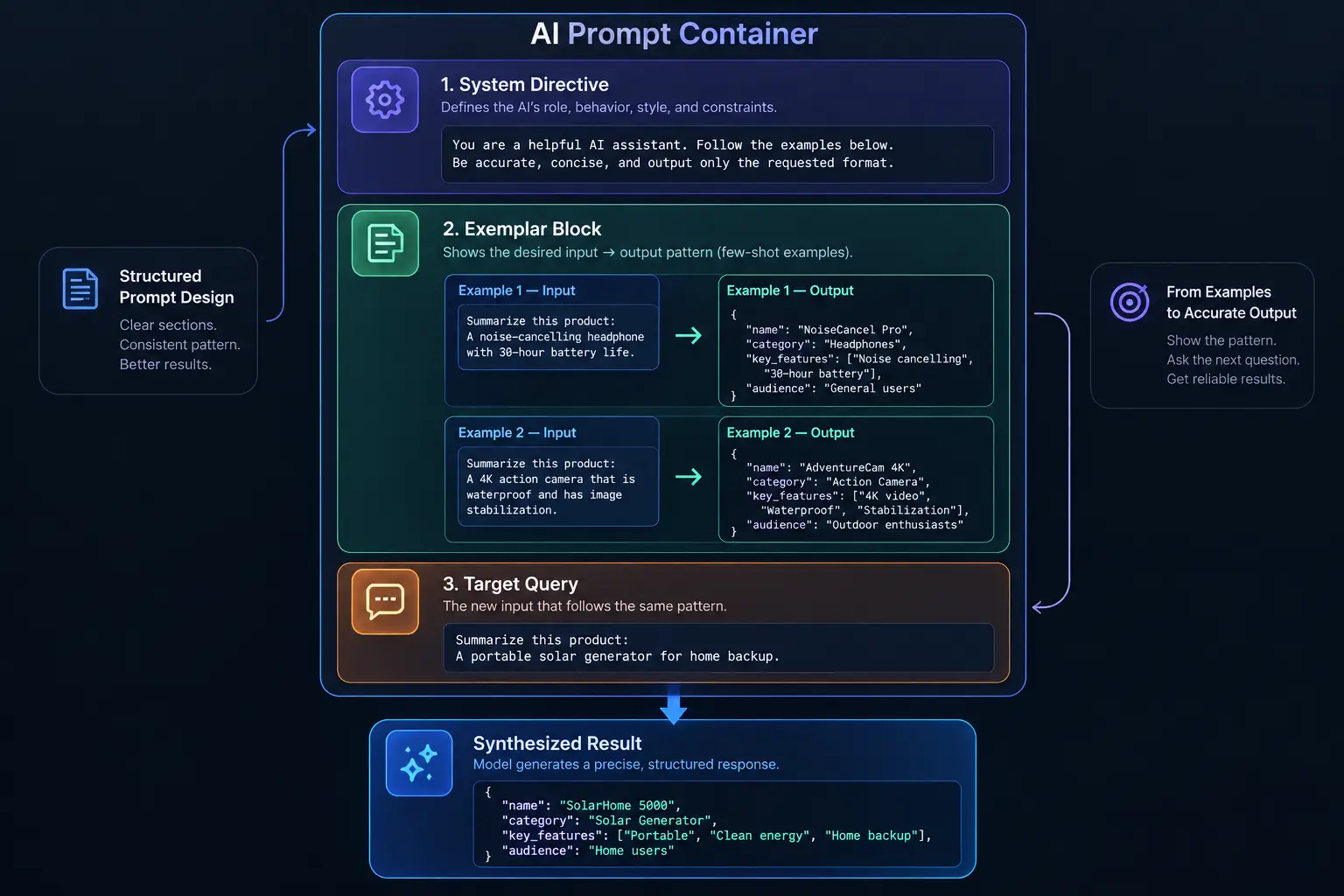
The Anatomy of an Exemplar Block
To get dependable results, I structure prompts using a standard exemplar pattern. It separates instructions, few-shot demonstrations, and the active task using distinct delimiters.
Here is a practical comparison. Notice how the rule-based prompt begs for tone, while the few-shot template forces tone through demonstration.
[POOR PROMPT: The Rule Stacker]
Rewrite this customer message. Make it warm, professional, and concise.
Do not use corporate buzzwords like 'synergy' or 'reach out'.
Sound empathetic but firm. Keep it under three sentences.
Message: "Your order got delayed because our warehouse lost power."
Compare that to this structural layout:
[HIGH-PERFORMANCE PROMPT: The Exemplar Format]
Task: Rewrite raw warehouse status updates into customer emails.
Tone: Calm, accountable, forward-looking.

---
Input: "Your shipment missed the truck because of system downtime."
Output: "Your package is running a few hours behind schedule due to a technical glitch this morning. We've re-routed it on the next transit window and updated your tracking link."

Input: "Item out of stock. You have to wait until Tuesday."
Output: "We're currently restocking your selected item and expect fresh inventory by Tuesday. We'll dispatch yours first thing Wednesday morning."
---

Input: "Your order got delayed because our warehouse lost power."
Output:
The difference is night and day. The model does not need to guess what you mean by "empathetic but firm." It sees the syntax, the sentence length, the level of detail, and the active phrasing directly in the examples.
This setup prevents the model from wandering off-topic, a persistent headache when you are managing context drift over long sessions.
 Why Giving AI Examples Beats Long Explanations
Handling Edge Cases Without Adding Words
What happens when your task has edge cases? The instinctive reaction is to add an addendum: "Note: if the user asks for a refund, do not grant it immediately, instead ask for their receipt."
When you pile notes on top of notes, models suffer from recency bias or positional degradation. Instead of writing conditional paragraphs, add an edge-case example directly into your exemplar block.
Human cognition thrives on pattern recognition, and transformer architectures mirror this behavior closely.
If you show the model:
- One standard case.
- One ambiguous case.
- One edge case.
You have effectively calibrated the model's response envelope across all common user scenarios.
This is why your complex extraction prompts fail when handling dirty data: you told the model what clean data looked like, but you never showed it how to behave when a field was missing.
Input: "Customer Name: John Doe | Phone: 555-0192 | Note: Needs morning delivery"
Output: {"name": "John Doe", "phone": "555-0192", "notes": "morning"}

Input: "Customer Name: Sarah Connor | Phone: N/A | Note: None"
Output: {"name": "Sarah Connor", "phone": null, "notes": null}
Notice that second pair. I did not write a rule explaining what to do when a phone number is missing. I simply demonstrated that N/A maps to null. The model will copy that logic without hesitation.
When complex tasks require dozens of conditions, combining this approach with chaining smaller prompt steps turns a fragile process into an industrial-grade workflow.
The Rule of Two
Whenever I design a prompt for myself or my team, I apply what I call the Rule of Two:
- If an instruction takes more than two sentences to explain, delete the explanation and replace it with two concrete examples.
- Include one example of the baseline standard and one example illustrating how to handle an ambiguous edge case.
You will immediately notice fewer hallucinations, cleaner formatting, and outputs that match your expectations on the first generation rather than the fourth.
If you are already using AI tools daily, take your most frustrating, convoluted prompt and strip out half the adjectives. Replace them with two clear input-output pairs today. The improvement will surprise you.
Frequently asked questions
How many examples are ideal for few-shot prompts?
Does few-shot prompting consume too many tokens?
Should I use synthetic AI examples or real human data?
Can I use examples alongside system instructions?
We build VirtuaChat and write about getting real work done with AI — prompting, models, images and audio.