
I still remember staring at our user metrics dashboard on a Tuesday morning, watching our gross monthly recurring revenue drop despite record-high signups. We were filling the top of our sales funnel, but our bottom line was leaking revenue faster than we could replace it.
Most software founders and team leads treat customer retention like a post-mortem exercise. They wait until a client clicks "Cancel Subscription" to ask what went wrong. By then, it is already too late.
If you want to build a sustainable business, you need to understand that churn rate isn't a surprise event. It is the end result of weeks of silent disengagement.
In this guide, I will break down how to spot churn signals weeks before they happen, fix onboarding leaks, and build an automated system to keep your users engaged.
The Silent Warning Signs Most Teams Ignore
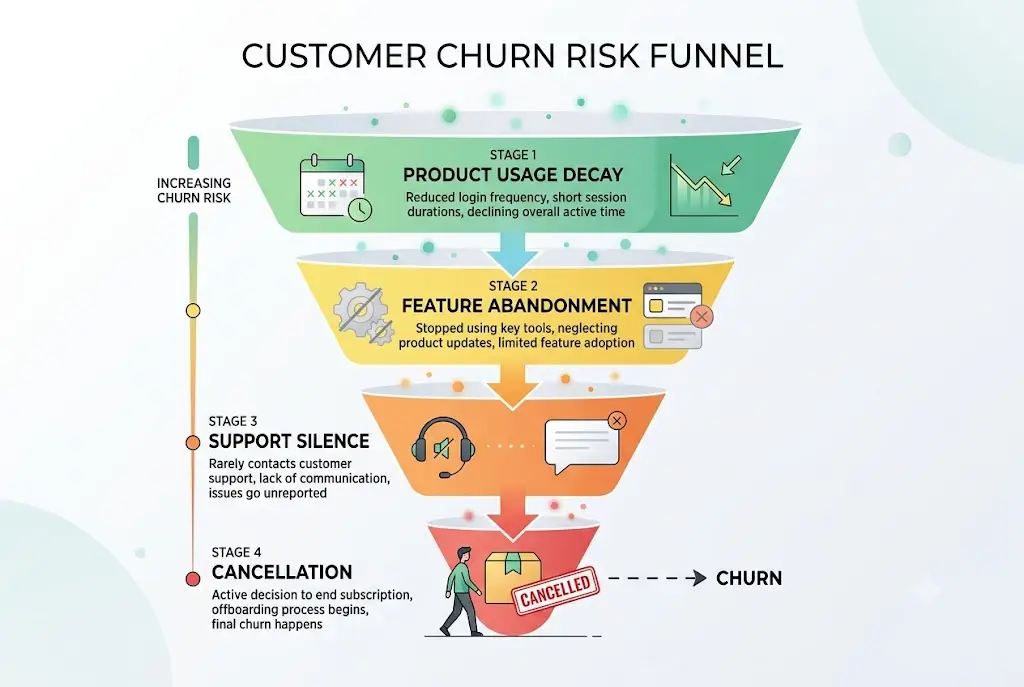
When a customer cancels, they rarely make the decision on impulse. In my experience running product workflows, users go quiet long before they pull out their credit card to stop payment.
The most dangerous form of disengagement is voluntary churn driven by declining product usage. If a user was logging in four times a week and suddenly drops to once every fortnight, their retention clock is ticking down.
This is why your active users drop off in week three without ever submitting a single support ticket or complaint.
Usage Frequency vs Feature Depth
Tracking overall logins can be deceiving. A user who logs in daily just to check a status setting is far more likely to leave than a user who logs in twice a week but utilizes three core workflows.
Unresolved In-App Friction
A subtle spike in repeat page visits without completing an action signals confusion. When users hit an unexpected barrier in your UI, they don't usually complain; they just close the tab.
 How to Cut Your SaaS Churn Rate Before Users Cancel
Why Traditional Retention Tactics Fail
When most business owners realize churn is creeping up, they launch reactive discount campaigns. They offer 20% off for three months if the user stays.
According to research by Bain & Company, increasing customer retention rates by just 5% can boost profits by 25% to 95%. Yet, throwing discounts at exiting users rarely solves the underlying cause of churn.
This is why sending a discount email after a customer hits cancel rarely brings them back for the long term.
A classic study published in the Harvard Business Review highlighted that customer defections are early signals of deteriorating value, not pricing friction. If users do not see recurring value in your tool, cheaper pricing only delays their departure.
If you struggle to retain context across customer touchpoints, take a look at how to prevent context drift in long customer retention tracking.
Building an Automated Early Warning System
To fix churn before it happens, you need a system that flags user risk scores dynamically. You can build this using simple database triggers or custom analytics setups.
We can apply predictive analytics to cross-reference login frequency, feature usage depth, and team seat adoption.
{
  "user_health_score": {
    "account_id": "usr_99421",
    "metrics": {
      "days_since_last_login": 12,
      "core_feature_usage_drop_pct": 65,
      "open_support_tickets": 2
    },
    "risk_level": "HIGH",
    "recommended_action": "trigger_personalized_cs_checkin"
  }
}
When an account shifts into the high-risk zone, your system should automatically alert your customer success team or trigger an in-app prompt.
If you are evaluating which analytical model works best for processing customer telemetry data, check out our guide on how to pick the best AI model for workflow analytics.
| Risk Level | Behavioral Signal | Triggered Intervention |
|---|---|---|
| Low Risk | Daily logins, multi-feature adoption, seat expansion | Automated power-user tip or feature preview |
| Medium Risk | Weekly login drop > 30%, no new feature usage | Targeted in-app tutorial or context-aware workflow guide |
| High Risk | No core actions for 10+ days, unanswered support email | Direct human outreach from Customer Success |
Fixing Onboarding Friction Points
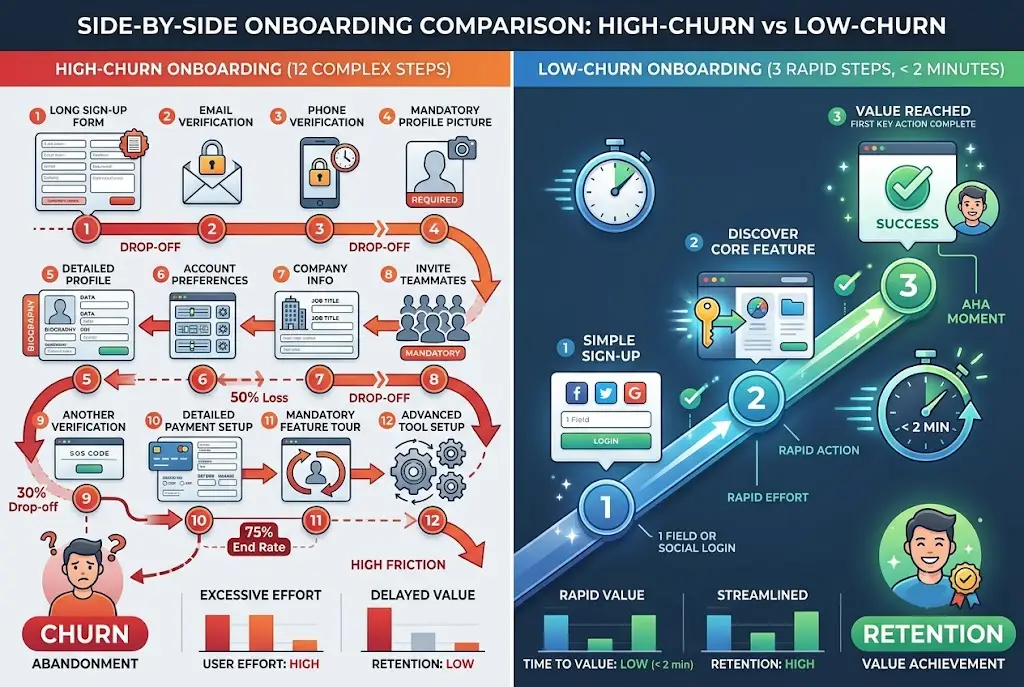
The fastest way to decrease churn is to compress the time it takes for a new signup to reach their "Aha!" moment.
If a new sign-up doesn't experience tangible value within their first two sessions, the probability of 90-day churn increases exponentially. Gartner customer research reveals that reducing friction points along early lifecycle stages directly correlates with multi-year contract renewals.
This is why your user's trial expires before they ever click the main export button in your interface.
 How to Cut Your SaaS Churn Rate Before Users Cancel
3 Steps to Optimize Time-to-Value
- Remove Optional Form Fields: Don't ask for company size, role, or phone number during initial signup unless it strictly customizes the product interface.
- Guide with Actionable Templates: Instead of a blank workspace, provide pre-populated templates that demonstrate instant utility.
- Focus on One Key Action: Identify the single action that correlates with long-term retention (e.g., creating a first project or inviting a team member) and focus the entire onboarding checklist on that single metric.
To scale these operational improvements across complex internal processes, learn more about mastering multi-step workflows.
The Retention Playbook for Modern SaaS
I always tell teams that retention isn't a single feature; it is an organizational habit. When you align product development, customer success, and messaging around user value, your churn metrics naturally stabilize.
Start by auditing your user journey today. Identify where drop-offs happen, establish your automated early warning triggers, and focus on delivering immediate value.
If you are already running a digital business, implementing even one proactive retention play this week will compound into significant revenue growth over the next quarter.
External References & Cited Research
- Bain & Company: Retaining Customers Is the Real Challenge — Research detailing how a 5% increase in customer retention can boost overall business profitability by 25% to 95%.
https://www.bain.com/insights/retaining-customers-is-the-real-challenge/ - Harvard Business Review: Zero Defection: Quality Comes to Services — Foundational research on customer defection economics and lifetime customer value.
https://hbr.org/1990/09/zero-defections-quality-comes-to-services - Gartner Research: Reduce Churn Along the Customer Journey — Industry analysis on monitoring and reacting to disengagement signals across customer lifecycles.
https://www.gartner.com/en/documents/5948332
Frequently asked questions
What is considered a healthy SaaS churn rate?
What is the difference between voluntary and involuntary churn?
How quickly can automated early warning systems reduce churn?
Should you offer discounts to keep churning customers?
We build VirtuaChat and write about getting real work done with AI — prompting, models, images and audio.