
"Do not mention competitors. Do not use corporate jargon. Whatever you do, do not write more than two paragraphs."
You paste the prompt, hit send, and wait. Three seconds later, the AI produces three dense paragraphs stuffed with buzzwords and a polite reference to your biggest rival.
It feels deliberate. It feels like the model examined your rules, identified everything you disliked, and served it back on a silver platter.
I spent months banging my head against this wall before looking at the underlying math. You are running into an architectural limitation inherent to how AI processes human language.
The Pink Elephant Trap in Modern LLMs
If I say, "Do not think about a pink elephant," your mind immediately pictures one. In cognitive psychology, this phenomenon is known as ironic process theory.
Large language models suffer from an identical issue, but for mathematical reasons rather than psychological ones.
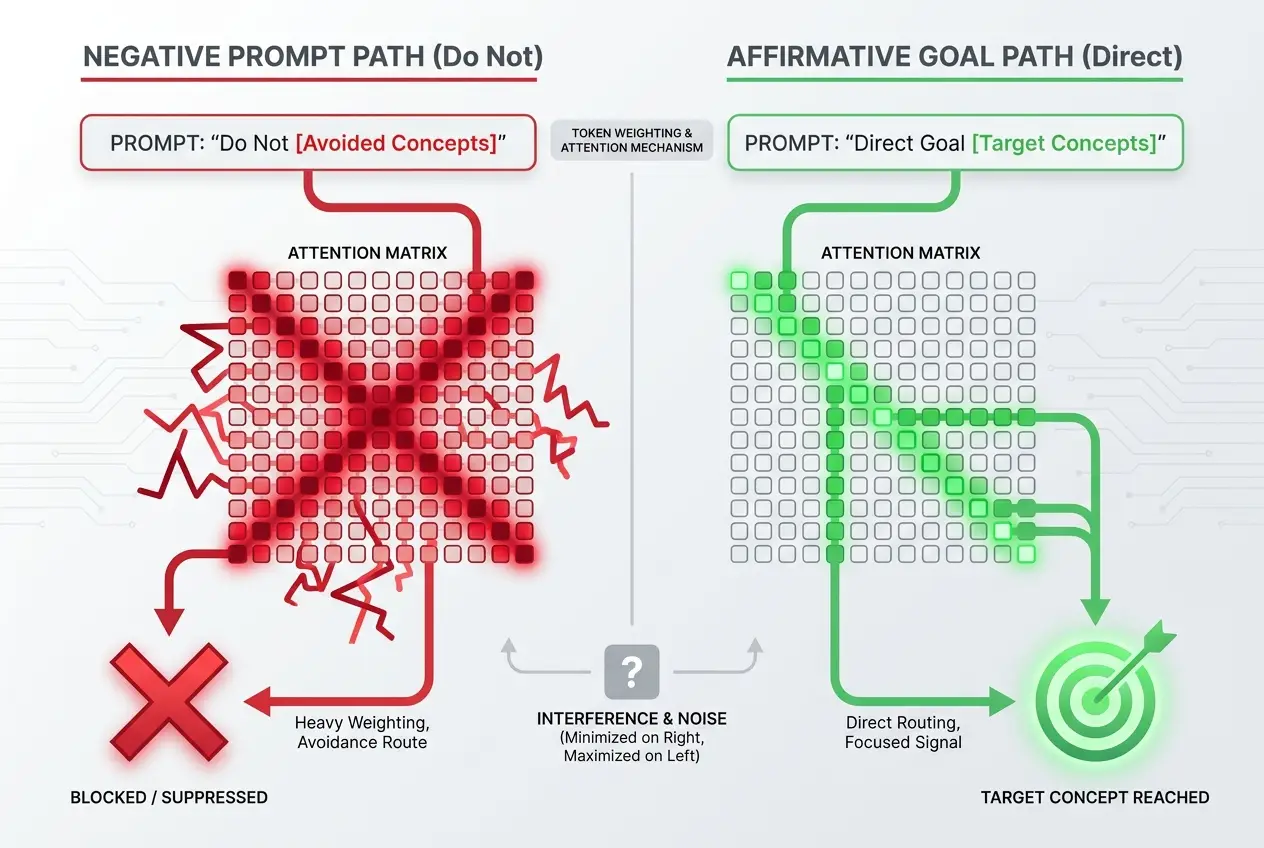
A modern large language model does not understand rules as conceptual boundaries. It calculates probabilities. When you write a negative prompt like "Do not include pricing," you introduce the token pricing into the model's context window.
Through the model's attention mechanism, every subsequent token generated by the model now assigns higher mathematical weight to concepts linked to "pricing."
 Why Telling AI What NOT to Do Fails (And the Fix)
You intended to build an electric fence. Instead, you handed the model a highlighter.
This is why your AI draft includes the exact buzzwords you explicitly banned in your first sentence.
This is why negative constraints fail when your conversations get longer: the token you tried to forbid is now anchored in the history of the chat.
Why Negation Breaks Next-Token Prediction
Every generative text system operates as an autoregressive model. It generates text by predicting the single most likely token to follow the sequence before it.
The token "not" requires the AI to comprehend a multi-step logical chain:
- Identify the forbidden concept.
- Evaluate alternatives.
- Select a token that satisfies the context while completely excluding the forbidden concept.
Most models struggle with multi-step logical inversions during instantaneous generation. As Anthropic's technical documentation bluntly notes: "Tell the model what to do instead of what not to do. LLMs are notoriously prone to ignoring negative constraints."
When you tell an AI, "Don't be conversational," the model activates every embedding related to "conversational," pulls them closer in vector space, and generates a polite greeting anyway.
This is why telling your coding assistant "don't use third-party libraries" often results in an external import statement on line one.
This breakdown is also connected to how formatting rules fail when you load your prompt with excessive structural commands. When cognitive load stacks up, the negative particle drops out of the model's focus first.
Four Ways to Replace 'Don't' With Real Control
You do not need to pray that the model follows your negative instructions. You only need to rephrase your constraints into affirmative, non-negotiable paths.
1. Affirmative Substitution
Never tell the model what to omit without defining what must take its place.
If you want an informal tone removed, state the exact register, target publication, or persona you expect. Give the model a target to aim at, not a void to avoid.
# WEAK (Negative Constraint)
Write a summary of this report. Don't make it sound academic or stiff. Don't use bullet points.

# STRONG (Affirmative Substitution)
Write a summary of this report in conversational prose. Use short sentences, clear transitions, and write in the editorial style of the Morning Brew newsletter.
2. The Allowlist Approach
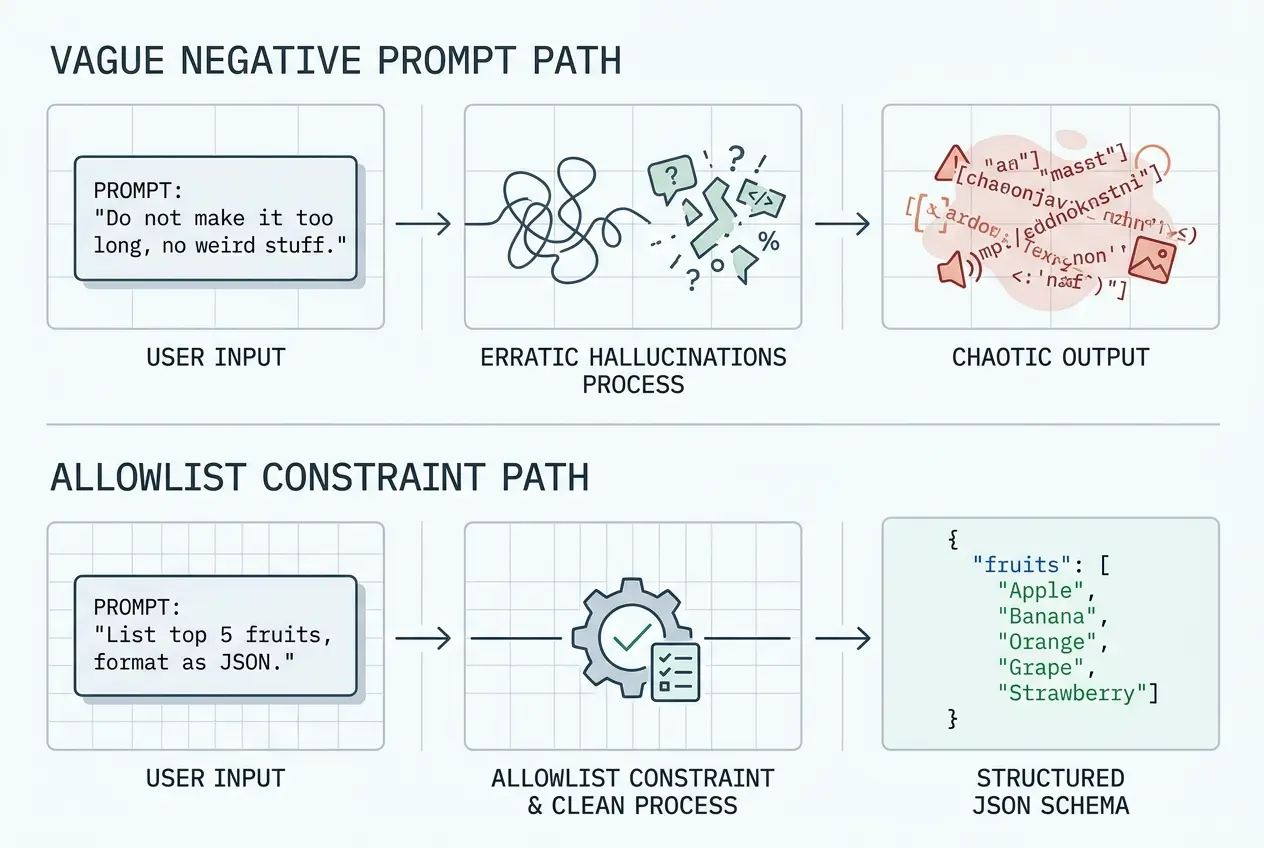
When you tell an AI "don't include X, Y, and Z," you leave an infinite number of alternative pitfalls open.
Flip the logic: define the only things the model is allowed to output.
# WEAK
Extract the names and roles from this email. Do not include their contact info or notes.

# STRONG
Extract names and roles from the email. Return strictly a JSON array where each object contains only two keys: "full_name" and "job_title".
By constraining the schema, you mechanically prevent unwanted data without ever mentioning the forbidden terms.
This is why your teammate who writes half as many prompt instructions often gets cleaner outputs than your five-paragraph list of negative restrictions.
 Why Telling AI What NOT to Do Fails (And the Fix)
3. Structural Isolation via System Rules
If a negative constraint is mission-critical, pull it out of the user task and place it inside the system instructions using explicit conditional rules.
As covered in our guide on system prompts that actually work, top-level system boundaries preserve their authority longer than casual instructions mixed into the body text.
Instead of writing "Don't give me the answer directly," configure the system prompt:
Role: Socratic Tutor
Execution: When the user asks a problem-solving question, respond exclusively with a diagnostic question that guides them toward the answer.
4. Two-Pass Verification
When working with critical documentation, complex code, or sensitive data, asking a single prompt to generate and police itself simultaneously is a recipe for failure.
Split the work into two distinct stages:
- Pass One: Ask the model to generate the draft.
- Pass Two: Feed the draft back into the model (or another model) with an editorial review rubric.
Review the draft above against this checklist:
- Remove any mention of competitor names.
- Replace any jargon with plain English equivalents.
- Ensure the total word count is under 200 words.
Output only the revised text.
This prevents context pollution and stops context drift from degrading your output over long sessions.
Negative Prompts vs. Affirmative Fixes
Here is how common negative instructions look when converted into deterministic, affirmative prompts:
| Instead of Saying (Negative) | Say This Instead (Affirmative) | Why the Fix Works |
|---|---|---|
| "Don't use corporate buzzwords." | "Write using concrete Anglo-Saxon verbs and everyday vocabulary." | Replaces vague bans with a concrete stylistic target. |
| "Don't make this email too long." | "Limit this email to exactly 3 sentences totaling fewer than 60 words." | Replaces subjective length with a quantifiable boundary. |
| "Don't write code using deprecated methods." | "Use Python 3.12 standard library functions only." | Restricts the search space to modern, validated APIs. |
| "Don't summarize the intro." | "Begin analysis directly from Section 2: Financial Metrics." | Tells the model where to start, skipping unwanted text. |
This is why swapping two words in your prompt template can eliminate entire rounds of back-and-forth editing.
Moving Beyond Trial-and-Error
Whenever you feel the urge to type words like don't, never, stop, or avoid, pause.
Ask yourself one question: If the AI cannot do this, what specific behavior should it exhibit instead?
Describe that target state directly. Give the model a clear track to run on, and you will never have to chase down pink elephants in your output again.
Frequently asked questions
Do negative prompts work better in image models than text models?
Does using capital letters like 'DO NOT' help the AI understand constraints?
Can few-shot examples fix negative prompt failures?
Why do frontier reasoning models handle negative constraints better?
We build VirtuaChat and write about getting real work done with AI — prompting, models, images and audio.