
I spent months believing that "training" an artificial intelligence model meant reserving cloud GPUs, converting gigabytes of text into JSONL files, and waiting hours for parameter weights to shift.
Every time an output misbehaved or drifted off-target, someone would insist: "You just need to fine-tune it."
They were almost always wrong.
For the vast majority of day-to-day use cases, the most impactful way to condition an LLM does not touch parameter weights at all. Exploring what practices are beneficial for training ai models with prompts comes down to harnessing in-context learning. By framing the model’s immediate context window as dynamic working memory, you can train reliable operational behavior in seconds.
This is why your AI outputs often look wildly unpredictable compared to an expert's, even when you both run the exact same underlying model.
The Myth of Weight Training vs. Prompt Conditioning
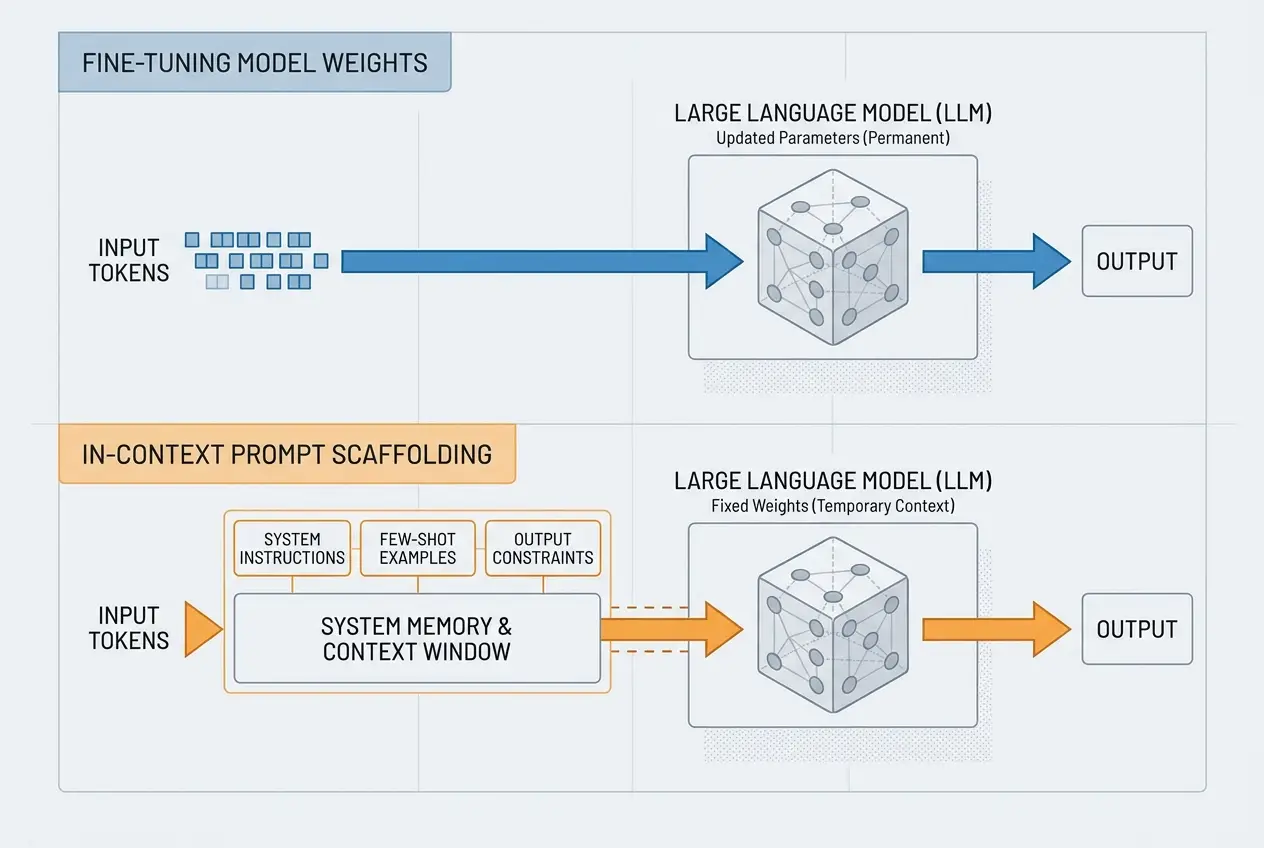
When teams talk about training an AI, they usually conflate two distinct processes: permanent weight adaptation and runtime prompt conditioning.
Permanent training updates the underlying neural network weights through gradient descent. Prompt-based training, by contrast, activates latent representations already buried inside the foundation model.
As AI researcher Andrej Karpathy pointed out, the context window of a modern large language model acts like the RAM of an operating system. What you feed into that RAM dictates how the central processor computes.
When you train a model via prompting, you aren’t teaching it English or basic math. You are building an execution sandbox with deterministic boundaries.
This is why your model behaves brilliantly on prompt one, but completely unravels by prompt ten if you haven't properly anchored its state.
 How to Train AI Models With Prompts That Stick
Practice 1: Anchor Behavior with Contrastive Few-Shot Pairs
Most practitioners rely on single-shot or basic few-shot learning by providing two or three "good" examples.
I found that this approach only solves half the problem. If you only show the model what success looks like, it guesses where the negative boundaries lie—and it usually guesses wrong.
The most effective technique when training models through prompts is contrastive few-shot pairing. You provide an input, a bad output highlighting the exact failure mode to avoid, an explicit critique, and the corrected version.
[INPUT]: Summarize our API rate limit policy for a non-technical customer.

[INCORRECT OUTPUT]: "Our REST endpoints enforce a leaky-bucket algorithm throttling requests to 60 req/min with HTTP 429 status codes."
[WHY IT FAILS]: Uses developer jargon instead of user-friendly guidance.

[CORRECT OUTPUT]: "You can make up to 60 requests every minute. If you exceed this, our system pauses new requests for 60 seconds to protect performance."
When you incorporate contrastive anchors, you eliminate the ambiguity that causes generic prose.
This is why your AI keeps generating conversational filler even after you explicitly tell it to "be concise"—you never showed it what unnecessary filler looked like in context.
If you are setting up global behavioral guardrails, pair this method with our guide on how to write system prompts that actually work.
Practice 2: Use Output Schemas as Cognitive Scaffolding
If your prompt relies entirely on natural language instructions like "Write a thorough report with three sections," the output will drift across iterations.
Language models think token by token. If the structure is fluid, the model spends attention heads deciding layout on the fly rather than refining logic.
To train an AI model reliably with prompts, enforce strict structural schemas such as JSON, YAML, or tightly marked Markdown tags. This practice is a pillar of modern prompt engineering.
### Analysis Specification
1. State the primary root cause in under 20 words.
2. Output a YAML block containing:
   - severity: [Low | Medium | Critical]
   - affected_components: [List]
   - rollback_required: [Boolean]
3. Provide a two-sentence remediation step.
By constraining the output syntax, you narrow the probability distribution of upcoming tokens. You eliminate guesswork.
This is why switching between prompt runs without a fixed schema leads to random formatting surprises in production workflows.
Practice 3: Order Context to Defeat Positional Decay
Where you position your instructions matters just as much as what you say.
Language models exhibit distinct attention biases. Information placed at the very beginning and the very end of a prompt receives disproportionately higher attention weights than information buried in the middle.
When structuring a comprehensive prompt to train a model for a workflow, I structure inputs using a deliberate four-tier hierarchy:
The 4-Tier Prompt Architecture
- Tier 1 (Top): Identity & Core Mission: The permanent perspective and non-negotiable rules.
- Tier 2 (Upper Middle): Reference Material: Unstructured source documents, raw data, or context.
- Tier 3 (Lower Middle): Contrastive Examples: Your few-shot positive and negative pairs.
- Tier 4 (Bottom): Immediate Task & Output Trigger: The precise execution command.
This layout prevents the phenomenon where AI ignores the middle of your prompts as conversation size expands.
This is why your AI suddenly disregards negative constraints the moment your background context passes two thousand words—the rules were buried where attention fades.
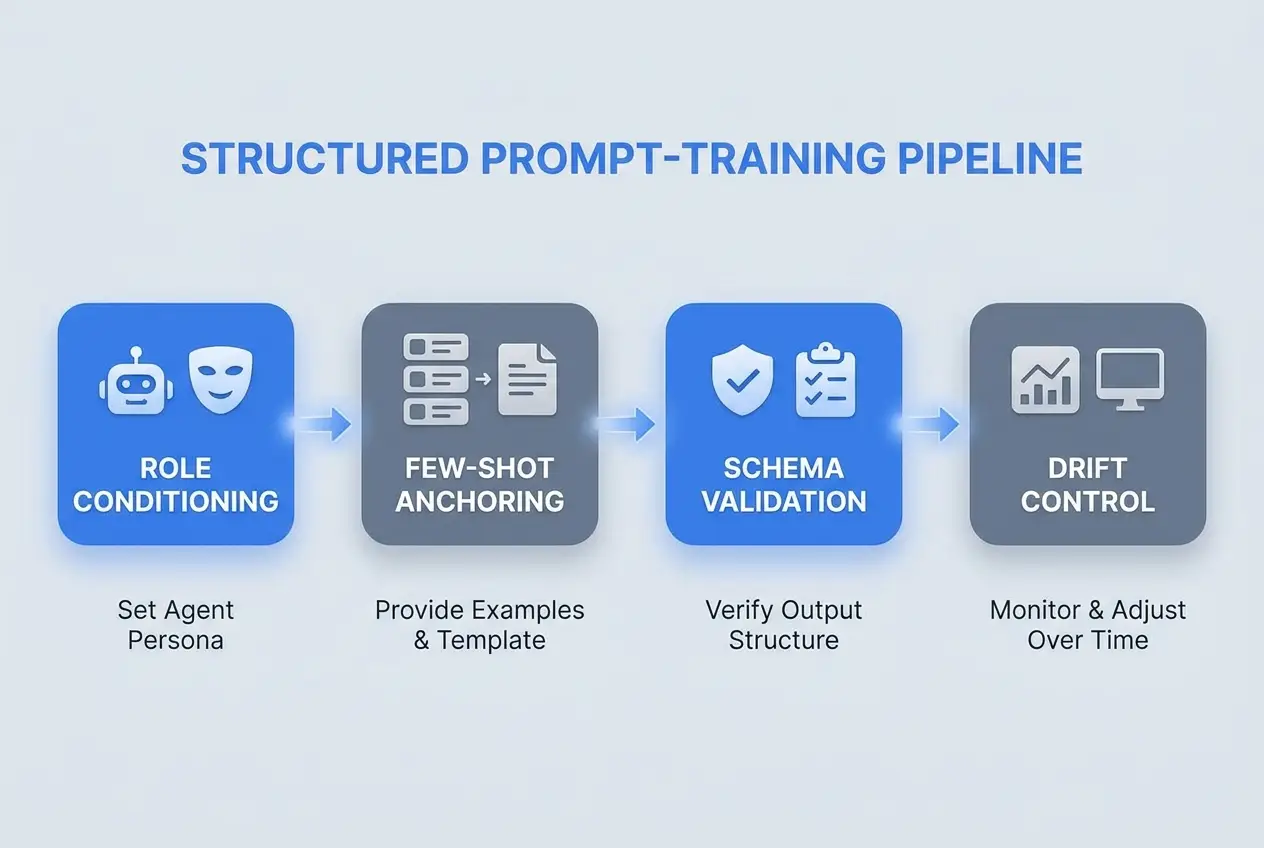
Practice 4: Track Context Drift Across Extended Sessions
Training an AI with prompts is rarely a one-shot event. You are usually guiding a model across multi-turn exchanges or iterative tasks.
The moment you enter multi-turn chats, earlier instructions risk being crowded out by recent conversational history. This is known as state drift.
| Approach | Setup Time | Flexibility | Cost | Best For |
|---|---|---|---|---|
| Basic Prompting | Seconds | Extremely High | Low | Simple queries, quick ideation |
| Prompt Training (In-Context) | Minutes | High | Moderate | Repeatable workflows, custom output formatting |
| Model Fine-Tuning | Days/Weeks | Low | High | Domain vocabulary, bespoke small architectures |
Unlike permanent fine-tuning, prompt training requires you to actively maintain conversational state.
If a multi-step session begins producing generic or degraded responses, do not continue feeding corrections into the chat. Reset the window and re-inject your structured prompt scaffold.
This is why managing context drift in long conversations is the single biggest productivity difference between novice users and advanced operators.
 How to Train AI Models With Prompts That Stick
Practice 5: Treat Prompt Templates Like Versioned Code
If you want an AI to behave like a trained asset, you must stop treating prompts like throwaway search queries.
I maintain prompt templates in plain-text markdown files, versioned in Git alongside production code. Every template contains explicit version notes, tested inputs, and edge-case criteria.
The Validation Checklist
- Boundary checks: What happens if the user inputs blank data?
- Tone invariance: Does the model retain its professional tone when challenged by conflicting user instructions?
- Format compliance: Does the output parse cleanly without markdown syntax errors?
When you treat prompt engineering with the rigor of unit testing, you convert an unpredictable text box into a dependable, production-ready microservice.
This is why a prompt that works smoothly on your personal machine can fail completely when a colleague runs it against messy, real-world data.
Mastering Runtime AI Conditioning
Prompt-based training is not a temporary workaround until you can afford fine-tuning. For most generative AI applications, it is the superior design pattern: faster to iterate, cheaper to maintain, and completely model-agnostic.
By combining contrastive examples, rigid schemas, positional attention awareness, and active drift control, you condition foundation models to deliver reliable, enterprise-grade output on command.
If you are using AI every day, picking one repetitive workflow this week and rebuilding it with structured few-shot scaffolding will immediately transform your results.
Frequently asked questions
Can prompt training completely replace traditional fine-tuning?
How many few-shot examples are needed to effectively train a prompt?
Does training models with prompts increase token consumption costs?
Why does an AI model stop following prompt training rules halfway through a chat?
We build VirtuaChat and write about getting real work done with AI — prompting, models, images and audio.