
You’ve been there. You paste the perfect prompt into one AI model, and the results are phenomenal. You try the exact same prompt in another model, or even the same model a week later, and get something completely different, maybe even something… less than stellar. It’s enough to make you wonder: Is AI just inconsistent, or am I missing something crucial?
I've seen this frustration countless times. People expect all AI models to be interchangeable, like different browsers rendering the same webpage. But AI models, especially large language models (LLMs) and image generators, are more like unique individuals. They have distinct personalities, strengths, and blind spots. Understanding why they differ is the first step to truly mastering them. This isn't just about tweaking prompts; it's about matching the right AI brain to the right task.
The AI Identity Crisis: Why Models Aren't Identical
The core reason for varying outputs lies in the fundamental differences between the models themselves. We often lump them all under "AI," but behind the curtain, they are complex systems built on distinct foundations. Think of it like comparing different breeds of dogs; they're all canines, but a husky, a poodle, and a bulldog have vastly different capabilities and temperaments.
This is why simply copying a prompt between a model like GPT-4 and Claude 3 can yield wildly different results. You're not talking to the same "entity."
Training Data Divergence: The AI's Worldview
Every AI model is trained on a massive dataset, but which data, how it's curated, and when it was collected significantly shapes its understanding of the world. Some models might have a stronger bias towards creative writing, having been trained on vast corpora of fiction and poetry. Others might excel at technical documentation, having ingested mountains of code, research papers, and developer forums.
I’ve personally observed how models trained more heavily on code repositories will produce cleaner, more syntactically correct code snippets, even with less specific prompting. Meanwhile, a model with a broader, more diverse text training set might offer more creative narrative options but struggle with niche programming logic. This is why one model might excel at creative writing, while another is a wizard with code. This foundation defines its "knowledge base" and its inherent biases. You can read more about how these models are built on Large language model concepts.
Architectural Nuances & Fine-Tuning Flavors
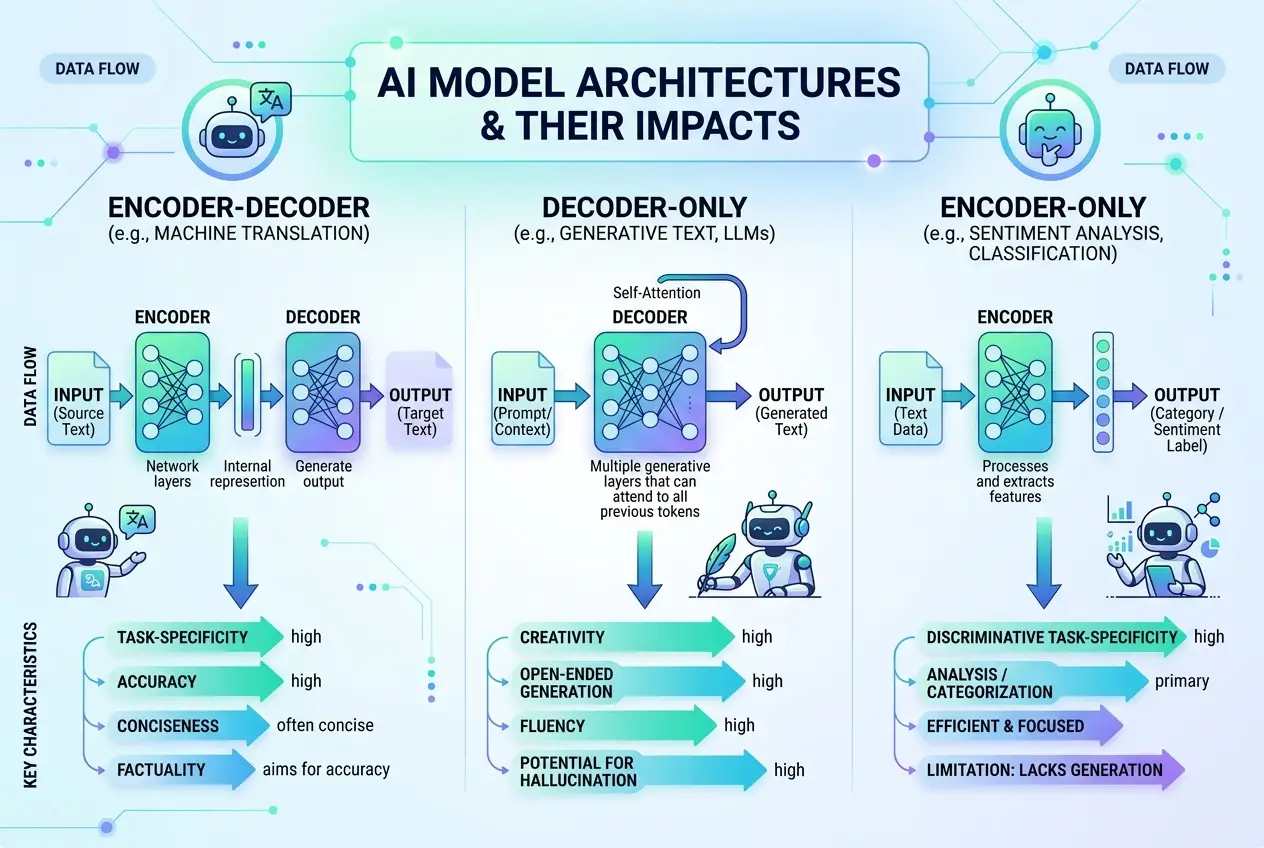
Beyond the data, the underlying architecture of an AI model plays a critical role. Most modern LLMs are based on the Transformer (machine learning model) architecture, but there are countless variations within this framework. Some might be designed for ultra-long context windows, others for rapid inference, and some for specific tasks like summarization or translation.
Then there's fine-tuning. After initial broad training, models undergo further specialization, often with human feedback (Reinforcement Learning from Human Feedback, or RLHF). This process molds their "personality" – making one more conversational, another more factual, and a third more cautious.
 Why Your AI Answers Differ Across Models (And How to Pick the Best One)
This is why some models are inherently better at generating long-form prose with a distinct voice, while others are concise and direct, prioritizing accuracy over flair. It's not just about the prompt; it's about the digital brain processing it.
The Prompt's Role: Context is King (Still)
While model differences are fundamental, your prompt remains the most direct way to influence output. What works brilliantly for one model might fall flat for another because each model "interprets" instructions through its own unique lens of training and architecture.
For example, some models thrive on highly structured prompts with clear role assignments and output formats. Others can be more conversational and perform well with natural language. I’ve noticed that overly verbose prompts can sometimes confuse more "concise" models, leading to less focused answers. Conversely, a minimalist prompt might leave a highly adaptable model feeling adrift. This is why a detailed prompt for one model might overwhelm another, leading to a poorer result. It's like giving cooking instructions to a master chef versus a novice; both need guidance, but the level of detail and type of language will vary.
If you're finding your AI outputs inconsistent, it might be worth reviewing your Prompt engineering techniques. A common mistake I see is people treating all models the same, even when their underlying mechanisms are vastly different. If you're struggling with getting consistent results, you might be falling into the trap of prompting AI wrong without realizing it.
How to Choose Your AI Champion: A Practical Guide
So, how do you navigate this multi-model landscape to get consistently better results?
1. Define Your Task (and Its AI Fit)
Before you even open a chat window, clarify what you want the AI to do.
- Creative Writing? You'll likely want a model known for its imaginative capabilities and fluidity.
- Code Generation/Debugging? A model with strong coding datasets and logical reasoning is key.
- Data Analysis/Summarization? Look for models with large context windows and a reputation for accuracy.
- Image Generation? Consider the style you're aiming for – photorealistic, artistic, abstract – as different image models excel in different aesthetics.
2. Understand Model Strengths & Weaknesses
Spend a little time learning about the general reputation and benchmarks of different models. While proprietary models like GPT-4, Claude 3, and Gemini Ultra often lead, open-source alternatives like Llama or Mistral also have specific strengths, especially when fine-tuned.
Here's a simplified view of how you might compare models for specific tasks:
| Task / Goal | Ideal Model Traits | Example Models (General) |
|---|---|---|
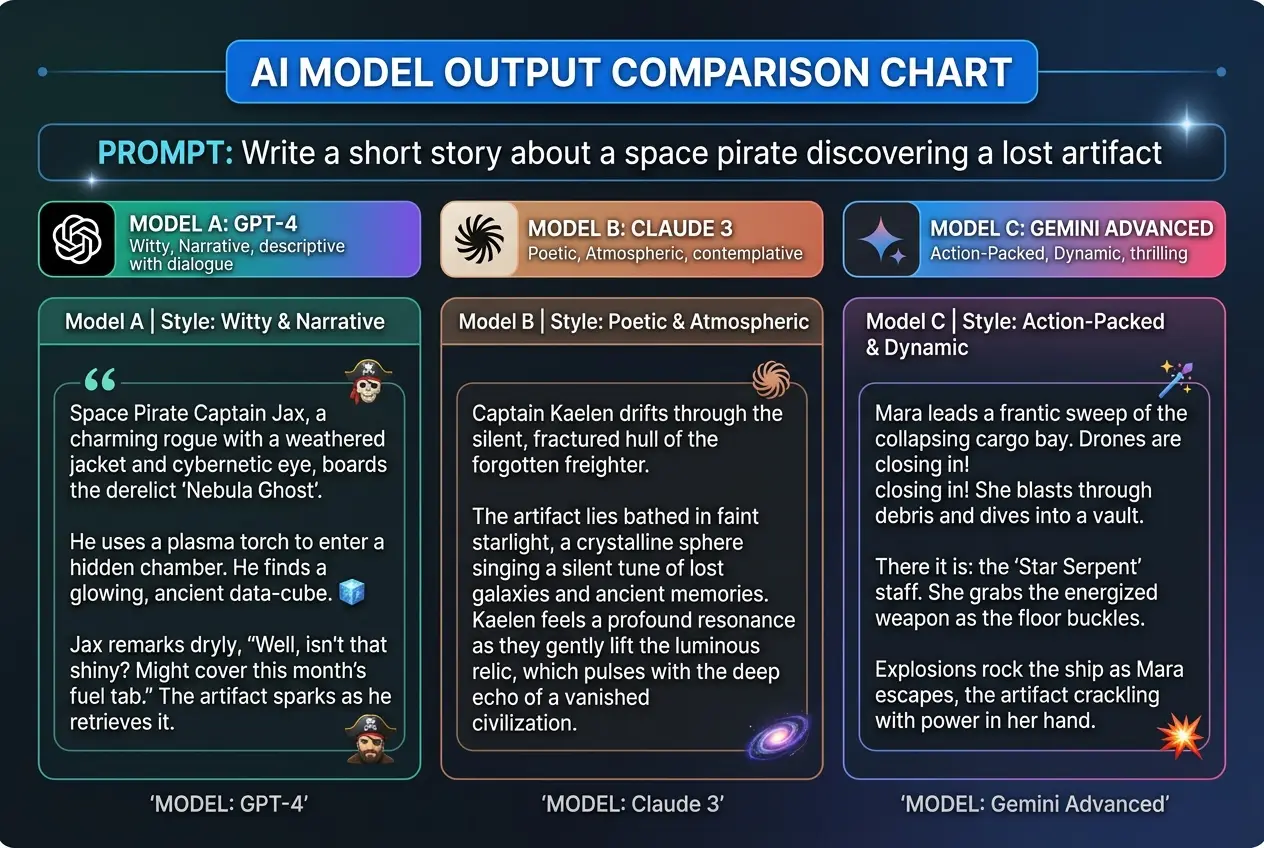
| Creative Writing | Imagination, narrative coherence, emotional depth, diverse stylistic range | Claude 3 Opus, GPT-4, Gemini Advanced |
| Coding Assistance | Logical reasoning, syntax accuracy, error detection, understanding of APIs | GPT-4, Gemini Advanced, specialized code models |
| Summarization | Large context window, ability to extract key points, conciseness | Claude 3 Opus, GPT-4, models optimized for long-form text |
| Factual Retrieval | Access to up-to-date knowledge base, ability to cite sources (if applicable) | Gemini Advanced (with real-time info), GPT-4, specialized knowledge bases |
| Image Generation | High fidelity, specific artistic styles, understanding of complex compositions | Midjourney, DALL-E 3, Stable Diffusion (with fine-tuned checkpoints) |
 Why Your AI Answers Differ Across Models (And How to Pick the Best One)
3. Test and Iterate
There's no substitute for hands-on experience. Take a specific task you want to accomplish and try it across a few different models. Compare the outputs, note the nuances, and adjust your prompts accordingly. I often keep a "prompt journal" to track what works best for which model and task.
The Multi-Model Advantage: Orchestrating Your AI Team
The true power of AI often isn't in finding one perfect model, but in understanding how to leverage multiple models for a single, complex workflow. I think of it as assembling a specialist team. You wouldn't ask your creative writer to debug code, and you wouldn't ask your programmer to draft a marketing campaign. The same applies to AI.
You might use one model known for its creative brainstorming to generate initial ideas, then feed those ideas into a more structured model to outline a plan, and finally use a coding-focused AI to write the actual code. This kind of multi-stage approach is increasingly common among advanced users and can dramatically improve efficiency and output quality. This is why the pros don't just stick to one AI; they orchestrate a team of digital brains. This approach, sometimes called "AI workflows," is a game-changer for productivity. You can learn more about how to unlock advanced multi-step AI projects by thinking about chaining AI capabilities.
The field of Artificial intelligence is evolving rapidly, and staying current with model capabilities is a continuous learning process.
Conclusion
The era of "one AI fits all" is rapidly fading. To truly get the most out of these powerful tools, you need to understand their individual personalities, strengths, and weaknesses. By recognizing why your AI answers differ and intentionally choosing the right model for the right task, you'll move beyond frustrating inconsistencies and unlock a new level of AI-powered productivity. Start experimenting with different models for your routine tasks this week, and you’ll quickly see the difference.
Frequently asked questions
How often do AI models update, and how does that affect consistency?
Is it always better to use the most advanced or largest AI model?
Can I train an AI model to be more consistent for my specific needs?
How can I tell which AI model is best for a creative task versus a technical one?
If an AI gives different answers to the same prompt, how do I know which one is 'right'?
We build VirtuaChat and write about getting real work done with AI — prompting, models, images and audio.