
You type a prompt, glance at the screen, and add a quick finishing line: "Keep it brief. Be concise."
It feels like common sense. You do not want a 900-word corporate essay when all you needed was an answer.
Then the output arrives.
The prose feels hollow. Key caveats disappear. Subtle edge cases get flattened into vague generalities, and the answer suddenly sounds like an over-caffeinated marketing intern skimmed the surface of your problem.
I spent months wondering why my most compact prompts generated my worst AI answers. It turned out the culprit was not the underlying model's intelligence—it was the exact phrase I thought was keeping it sharp.
Telling an AI to "be concise" is one of the most reliable ways to degrade reasoning quality. Here is why it happens, what happens beneath the prompt window, and how to get dense, high-signal answers without triggering output rot.
 Why Telling AI to Be Concise Ruins Your Output
The Hidden Penalty of Token Starvation
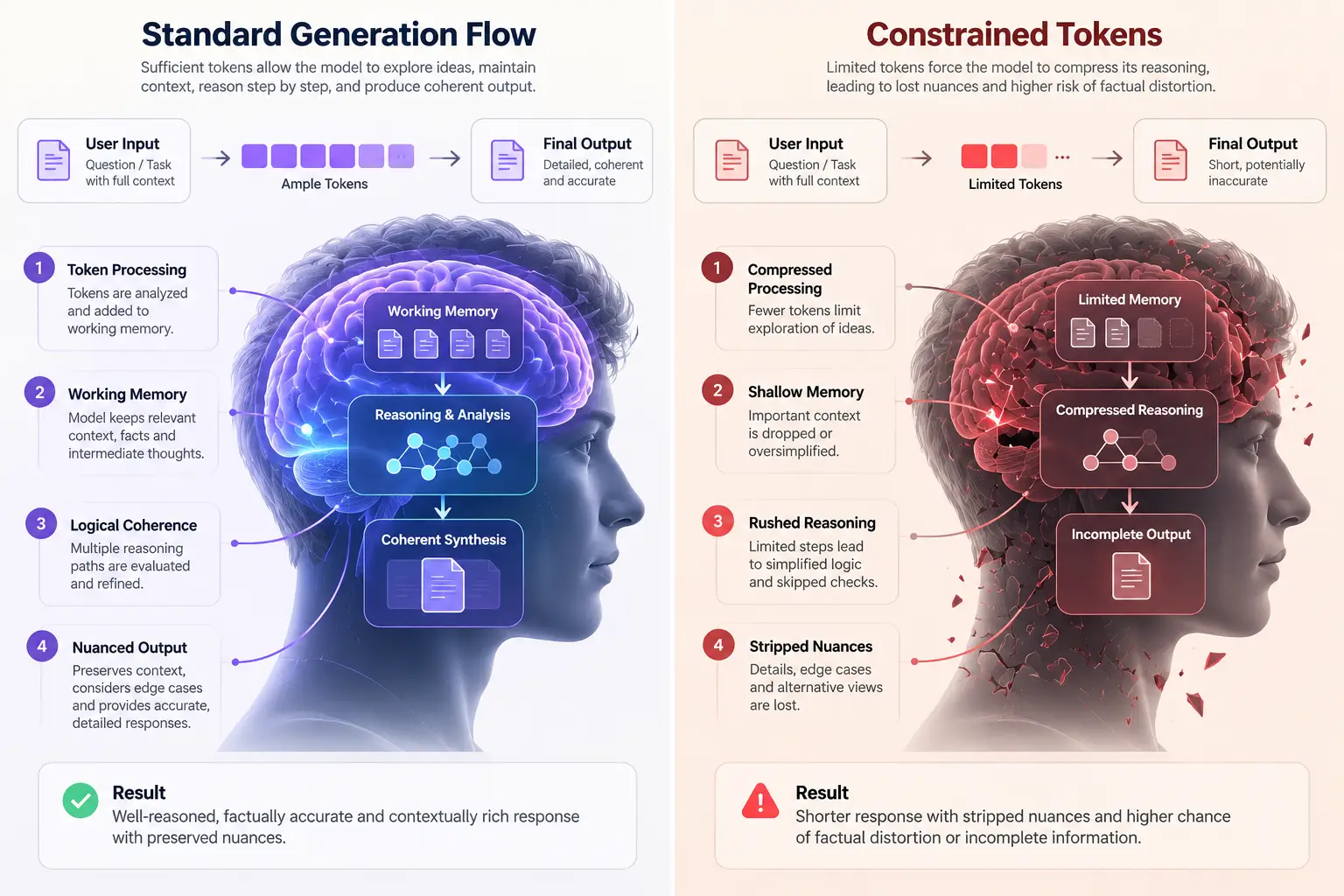
Large language models do not think before they speak. They think as they speak.
Modern architectures rely on the Transformer mechanism, generating answers token by token through an autoregressive model process. Every new token the AI outputs acts as working memory for the next calculation.
When you demand brevity upfront, you restrict that working memory. You force the model to commit to answers before it has laid down enough context tokens to evaluate logic, verify constraints, or weigh tradeoffs.
As machine learning researcher Andrej Karpathy once noted regarding model reasoning, giving an LLM "room to think" via output tokens directly correlates with its problem-solving accuracy. When you choke off token volume at the start, you starve the model's analytical pipeline.
This is why your teammate who writes slightly longer, descriptive instructions gets nuanced, surgical answers while your two-sentence query returns generic fluff.
Why Brevity Spikes Hallucinations
When an AI cannot use tokens to construct intermediate reasoning steps, it takes statistical shortcuts. It substitutes depth with probability.
In technical analysis, code reviews, or strategic summaries, the most critical details often live in the edge cases. But edge cases require explanatory setup. If you demand two sentences, the model discards those edge cases in favor of the highest-probability, most generic patterns in its training weights.
Worse, extreme brevity frequently triggers false confidence. We already explored why AI hallucinates facts under pressure, and forcing an artificial word cap supercharges that tendency. The model will invent a clean, brief conclusion rather than spend tokens acknowledging nuance or missing information.
This is why stripping word count on technical or legal prompts often introduces subtle errors that take double the time to debug later.
| Prompt Approach | Model Behavior | Output Quality | Primary Failure Mode |
|---|---|---|---|
| "Be concise" | Compresses generation layer immediately | Shallow, generic | Omits essential nuance; higher error rate |
| "Max 2 sentences" | Truncates syntax to meet strict token cap | Stilted, robotic | Cuts off reasoning before verification |
| Reason First, Condense Second | Calculates intermediate steps before summarizing | Dense, accurate | Slightly longer prompt execution |
| Structural Schema (Bullets/Table) | Organizes high-density tokens into fixed shapes | High signal, scan-friendly | Requires deliberate template framing |
How You Accidentally Strip the Voice
Beyond accuracy, "be concise" drains the personality and voice right out of language.
When people ask for brevity, what they usually want is high information content—what writers call "density." But large language models interpret "be concise" as syntactic minimalism.
Instead of delivering punchy, high-impact insight, the AI resorts to buzzwords, passive clichés, and flattened vocabulary. This dynamic explains why AI writing sounds robotic even when the core information is theoretically accurate.
This is why your summary of a complex whitepaper reads like an uninspired press release whenever you attach "keep it short" to the end of your prompt.
 Why Telling AI to Be Concise Ruins Your Output
3 Ways to Get High Density Without the Fluff
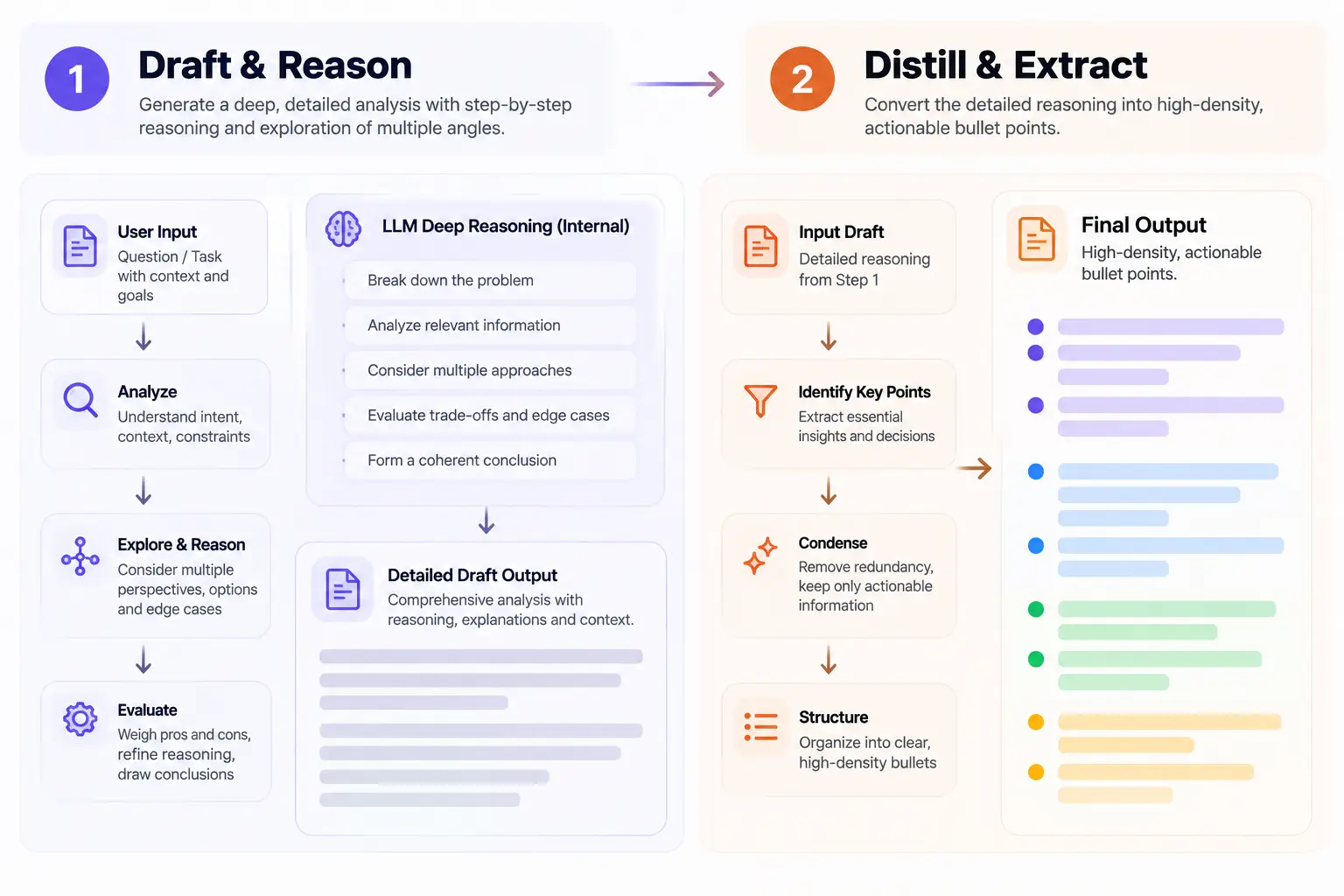
You do not have to accept 1,200-word walls of text just to maintain accuracy. The secret lies in separating the thinking phase from the formatting phase.
Here is how I structure prompts to maintain deep reasoning while keeping the final answer scannable.
1. The "Think First, Deliver Second" Pattern
Allow the model to unpack its reasoning before asking for the concise takeaway. Giving the model computational space prevents token starvation.
Analyze the tradeoffs between PostgreSQL and MongoDB for an append-heavy
telemetry service handling 50k events/sec.

Step 1: In 3-4 bullet points, outline the primary write-bottlenecks for each.
Step 2: Provide a final recommendation in under 100 words based on that analysis.
By placing the short requirement at the end, the recommendation benefits from the context generated in Step 1.
2. Impose Structural Constraints Instead of Length Caps
Telling an AI "don't ramble" triggers unpredictable behavior, matching what we saw when examining why telling AI what not to do fails. Instead, give the AI a format that naturally enforces brevity through structure.
Effective structural constraints include:
- A Markdown table comparing three specific criteria
- A numbered list limited to three items, with a maximum of one sentence per bullet
- A strict executive brief schema: Problem, Root Cause, Action Item
This forces dense thinking into clear visual containers without stripping necessary context.
3. Use Two-Pass Editing for Critical Work
For mission-critical content—code architecture, client-facing memos, or executive proposals—never combine generation and compression into one turn.
Run the analysis at full length first. Let the AI examine nuances, explain dependencies, and double-check logic.
Once the output is factually complete, use a follow-up prompt:
Now edit this analysis for an executive reader. Remove all throat-clearing,
background definitions, and repetitive phrasing. Keep all metrics and specific
tradeoffs intact.
This second pass treats the first draft as working data rather than an unconstrained brainstorm. The result is razor-sharp precision without the risk of hallucinated shortcuts.
This is why two-step prompt refinement consistently outperforms single-shot commands across modern LLMs.
Stop Asking for Less Words—Ask for More Signal
The next time you catch your fingers typing "keep it brief," pause for a second.
You do not actually want fewer tokens. What you want is an answer that respects your time: zero introductory filler, concrete specifics, and immediate utility.
Give the model the room it needs to calculate the solution, dictate the layout you want to read, and trim the excess after the logic holds together. One structured prompt will save you three rounds of frustrating revisions.
Frequently asked questions
Does telling AI to be concise hurt performance across all models equally?
What is the difference between setting a low max_tokens parameter and asking for conciseness?
Can few-shot examples fix the conciseness penalty?
Why does asking for a specific word count often make AI writing worse?
We build VirtuaChat and write about getting real work done with AI — prompting, models, images and audio.