
You type a very clear instruction into your AI prompt:
"Write an introductory email of exactly 150 words."
The model responds instantly. The tone is sharp. The formatting looks clean.
Then you paste the text into a word counter, and it is 242 words.
Frustrated, you reply: "That was 242 words. I asked for exactly 150 words. Rewrite it and make it exactly 150 words."
The AI apologizes politely: "My apologies! Here is the revised draft in exactly 150 words."
You check the new draft. It is 187 words.
If you have spent any real time working with generative AI, you have run into this brick wall. It feels infuriating because writing 150 words is something an elementary school student can do with a pencil.
Why does an artificial intelligence system trained on trillions of words fail at simple counting?
The answer comes down to how machines process language. Once you understand the mechanism, you can stop fighting the model and use techniques that actually work.
The Tokenization Trap
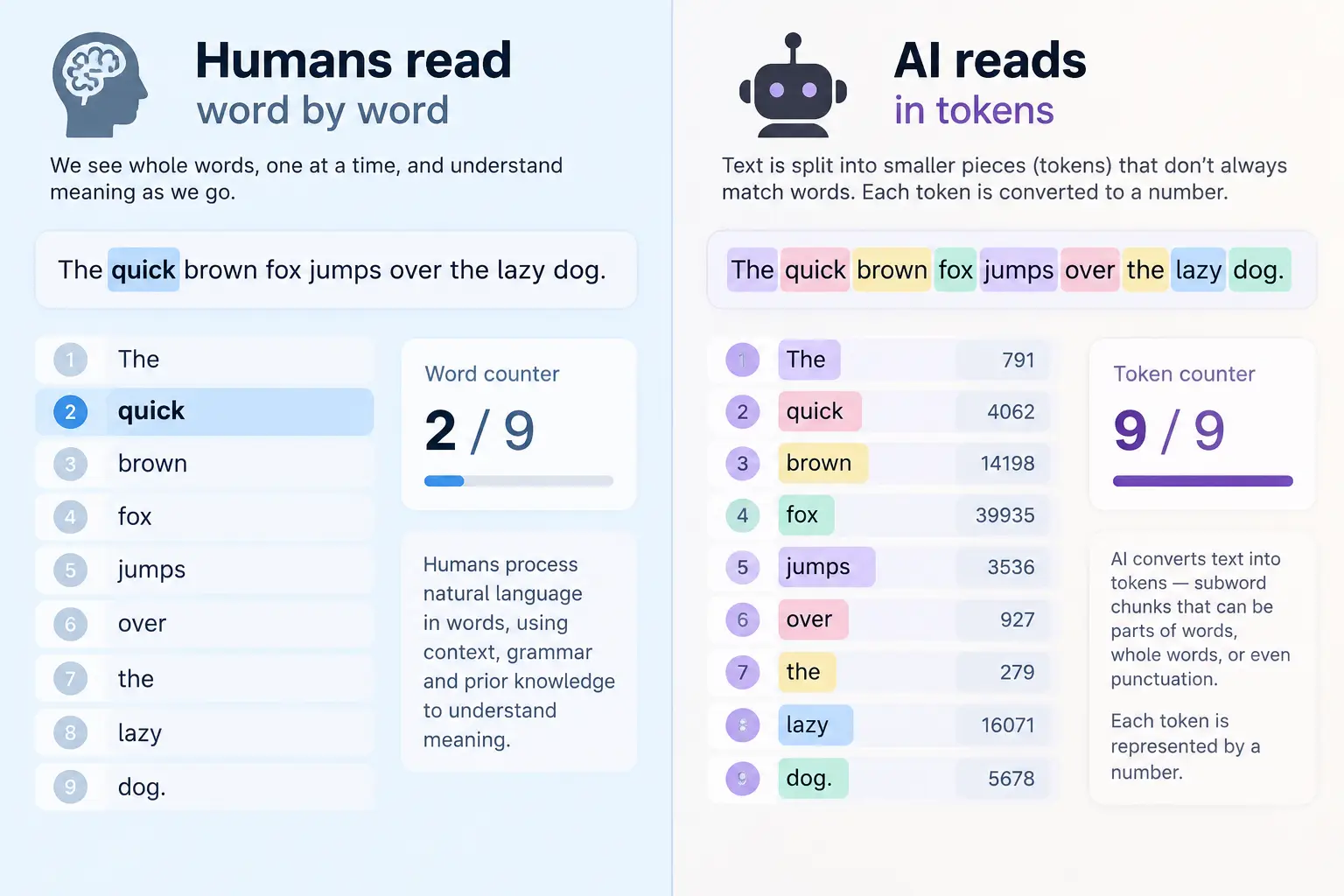
To understand why models struggle with word counts, you have to understand that models do not read words. They do not see letters either.
When you send a sentence to a large language model, your text gets broken down into numeric chunks called tokens. This process relies on algorithms like byte pair encoding.
A token can be a single character, a prefix, a whole word, or part of a word.
For instance, the word "apple" might be a single token, but "tokenization" might be split into two or three distinct tokens. Spaces and punctuation marks are often attached to words inside individual tokens.
This is why your 150-character meta description ends up being 210 characters—the model has no native concept of character or word boundaries while processing tokens.
 Why AI Can't Count Words (And How to Fix It)
Former OpenAI scientist Andrej Karpathy pointed this out directly when discussing language model idiosyncrasies:
"Tokens are the atomic units of LLMs... many apparent quirks in LLM behavior—spelling backward, counting letters, arithmetic—trace back to tokenization."
Because the AI only perceives token IDs, asking it to count 100 words is like asking a human to read an essay while simultaneously tracking the exact number of vowels without using fingers or scrap paper.
The AI does not have an internal counter incrementing in the background. It is simply picking the next most likely token.
The Autoregressive Dilemma
There is another structural reason your word counts fail: large language models are autoregressive.
An autoregressive model predicts the future strictly based on past tokens. It generates content left-to-right, one token at a time.
When an AI starts writing the first sentence of your requested "300-word post," it has no buffer where it pre-plans the entire structure. It cannot write 250 words, pause, check the remaining balance, and neatly draft a 50-word conclusion.
This is why your AI will happily write past your limit, panic near the end, and cut off awkwardly mid-argument.
It does not know how long the piece is going to be until it has already written it.
When you shout "EXACTLY 300 WORDS" in your prompt, the AI treats that number as semantic flavor rather than an absolute mathematical constraint. It knows the text should feel medium-length, but it cannot actively budget tokens against that goal in real time.
Much like why AI ignores your formatting rules, length violations are an architectural limitation, not stubbornness.
| Prompt Approach | Accuracy Rate | Predictability | Best Use Case |
|---|---|---|---|
| "Exactly X words" | Very Low (~15%) | Poor | Rarely recommended |
| "Under X words" | Moderate (~60%) | Fair | Quick drafts |
| Structural targets (paragraphs/bullets) | High (~85%) | Strong | Content outlines |
| Token budgets via system parameters | Highest (~95%) | Consistent | API & production workflows |
3 Prompting Fixes That Actually Work
If you need precise lengths for essays, social posts, or metadata, relying on word count prompts is a recipe for wasted time.
I stopped asking models for exact word counts months ago. Instead, I use structural proxies that give me the control I need.
1. Constrain Structure Instead of Words
Language models handle paragraph and sentence counts far better than word counts.
Tokens represent punctuation cleanly. A period, line break, or bullet point is an explicit token boundary that the model can track reliably.
Instead of writing:
Write a 120-word summary of this product update.
Try prompting like this:
Summarize this update in exactly 3 bullet points.
Each bullet point must be a single sentence containing no more than 15 words.
This simple shift gives the model clear stopping signals.
This is why your teammate's AI output looks tighter than yours—they are framing limits around sentence structure rather than abstract totals.
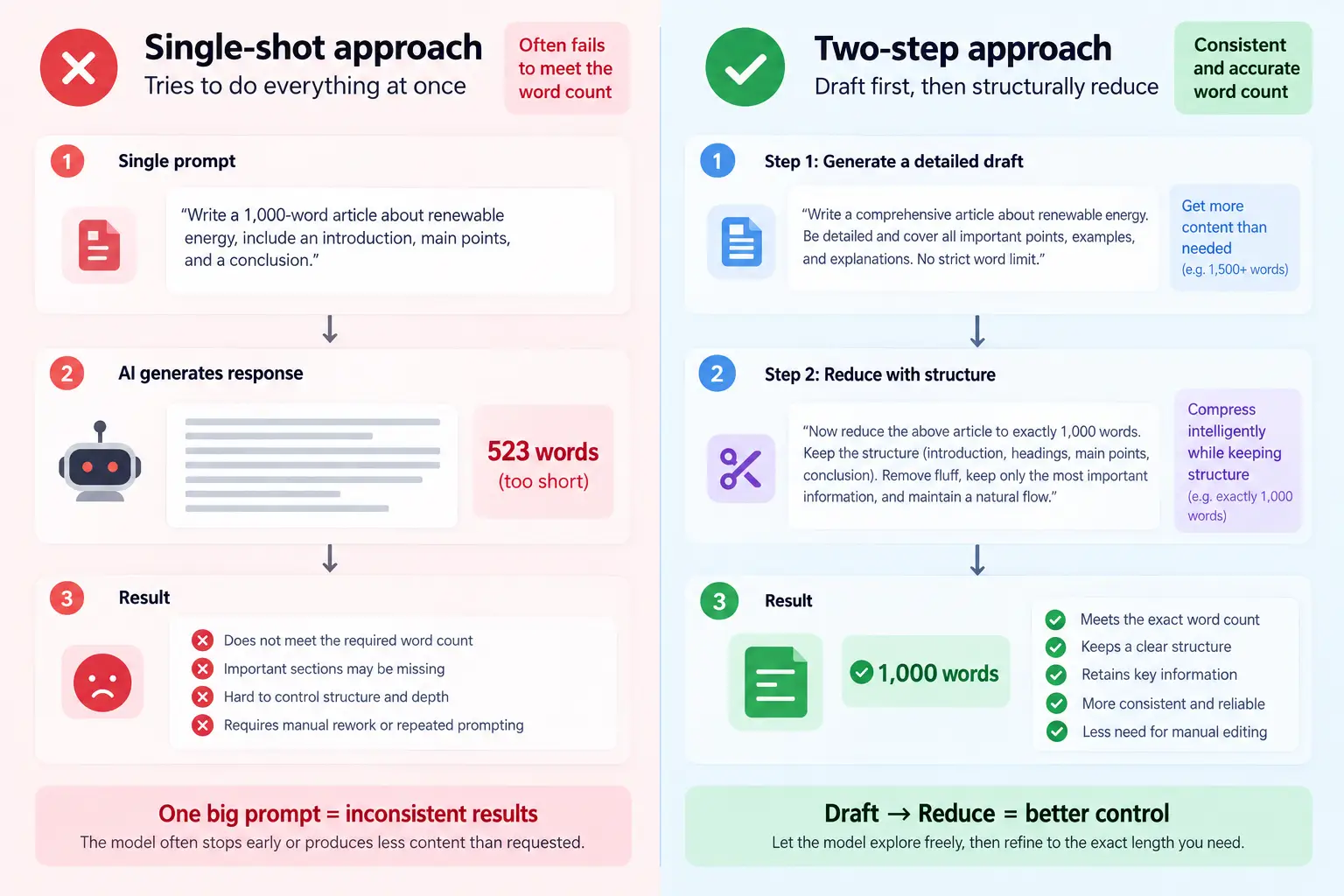
2. Use Negative Trimming Passes
When I need an exact length for tight layouts, I never try to hit the number on the first generation.
I let the AI draft freely with a broad ceiling first. Then, I run a reduction pass.
Here is the exact prompt structure I use:
Draft a brief product description covering [Topic]. Keep it under 200 words.

[Review output]

Now edit this draft down to strictly 4 sentences.
Remove all filler adjectives. Keep the strongest value proposition.
By decoupling the ideation phase from the editing phase, you allow the model to focus on information quality first and conciseness second.
This multi-step approach works on the same principle as prompt chaining beats one giant prompt: you get superior results when you divide complex constraints into separate steps.
 Why AI Can't Count Words (And How to Fix It)
3. Estimate by Token Ratio
If you work with AI platforms or API settings, you can control output length using max token parameters rather than conversational text prompts.
A general rule of thumb for standard English text is:
- 1 token ≈ 0.75 words
- 100 words ≈ 130–140 tokens
If you want a response that stays under 100 words, set your completion threshold or generation limit to roughly 135 tokens.
The model literally cannot exceed that budget because the generation loop terminates once the token limit is reached.
This is why code execution setups and developer environments nail length constraints while standard chat interfaces wander.
Stop Fighting the Architecture
Language models are reasoning engines and stylistic mirrors, not pocket calculators.
When you demand that an AI write "an article of precisely 450 words," you are asking a system built on statistical probabilities to perform deterministic counting.
Switch your strategy:
- Target paragraph and sentence counts.
- Use explicit bullet boundaries.
- Edit down in a dedicated second step.
Once you stop treating word counts as a test of the AI's intelligence and start designing prompts around token realities, your outputs become predictable, clean, and immediately usable.
Frequently asked questions
Do newer reasoning models solve the word count problem?
Why does AI struggle more with character counts than word counts?
Can using Python code interpreter in AI tools guarantee exact counts?
Does writing in languages other than English affect token-to-word ratios?
We build VirtuaChat and write about getting real work done with AI — prompting, models, images and audio.