
You ask an AI model to write a two-sentence Slack update explaining a delayed project deliverable.
Instead of an instant, casual reply, your screen pauses. A little spinner flickers: Thinking for 22 seconds...
When the output finally lands, it reads like a risk-management thesis. You get an itemized taxonomy of delivery friction, mitigation strategies, and formal probabilistic milestones.
You wanted an apology and an ETA. You got a doctoral dissertation.
I see this frustration daily among power users who assume that newer, "smarter" reasoning models should replace every standard chat model in their stack. We have been conditioned to believe that deeper compute always equals superior quality.
In reality, applying a dedicated reasoning model to everyday tasks does not just waste time—it actively degrades the quality of your output.
The Illusion of Universal Intelligence
When large language models evolved to include hidden reasoning tokens and test-time search, benchmarks surged across competitive math, cybersecurity auditing, and multi-step logic.
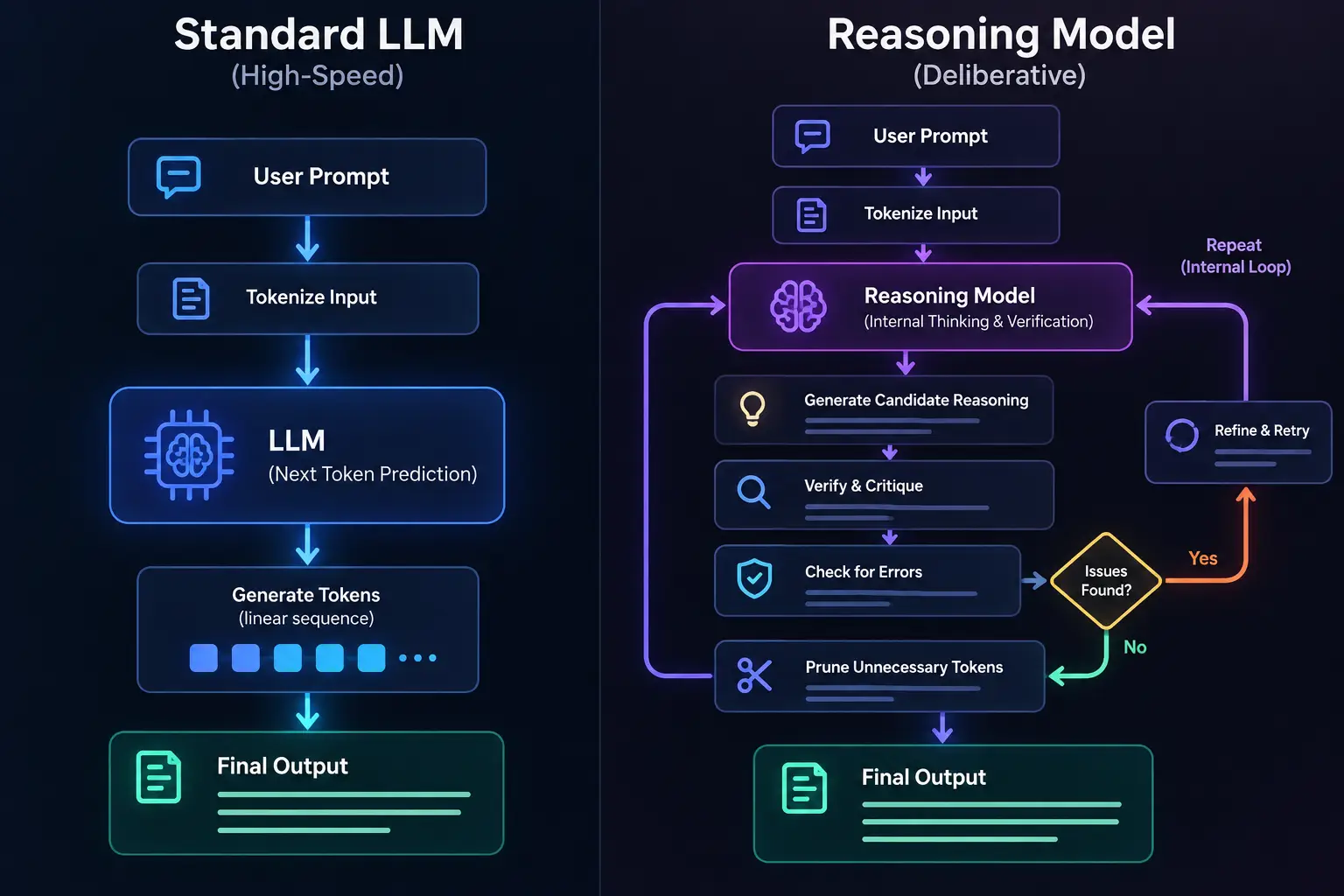
These architectures use reinforcement learning to simulate human reflection. They generate internal scratchpads where they hypothesize, verify, backtrack, and synthesize before displaying a single word.
[Standard LLM Flow]
User Prompt ──► Direct Autoregressive Prediction ──► Final Output (0.4s)

[Reasoning Model Flow]
User Prompt ──► Internal Scratchpad ──► Self-Critique Loop ──► Backtracking ──► Structured Output (18.2s)
This deliberate deliberation is transformative when solving complex algorithms or untangling conflicting legal contracts. But routine productivity tasks require empathy, brevity, and stylistic intuition—not deduction.
This is why your simple email drafts end up sounding like legal disclaimers whenever you leave reasoning mode switched on by default.
 Why AI Reasoning Models Fail on Simple Prompts
Why Reasoning Models Overthink Routine Requests
Reasoning models are trained to prioritize correctness over conversational cadence. When you present an open-ended or subjective task, the model interprets the absence of explicit logic as a puzzle that needs solving.
If you submit a prompt like "Rewrite this product blurb to sound punchier," a standard model leans into creative vocabulary and cadence.
A reasoning model, by contrast, breaks your blurb into syntactic components, evaluates value propositions against marketing theory, deliberates over audience segmentation, and produces an over-engineered compromise.
Here is what happens behind the scenes during that deliberation:
- Pedantic constraint generation: The model creates arbitrary self-imposed rules to justify its computation time.
- Loss of natural tone: Nuance gets ironed out in favor of defensible, analytical phrasing.
- Hyper-hedging: The model attempts to resolve every potential counterargument before drafting the text.
This is why asking an overthinking model to brainstorm catchy taglines leaves you with sterile, academic phrases. For purely stylistic tasks, you run into the exact reasons why AI writing sounds robotic and how to fix it simply by using the wrong engine.
The Hidden Token and Latency Tax
Beyond stylistic stiffness, there is an operational penalty to using reasoning models indiscriminately.
Reasoning tokens do not appear on your screen, but they are generated, computed, and billed. A simple 30-word request can easily consume 800 hidden "thinking" tokens behind the curtain.
| Attribute | Standard Chat Models | Reasoning / "Thinking" Models |
|---|---|---|
| First Token Latency | 300ms – 900ms | 6,000ms – 30,000ms |
| Primary Strength | Fluid conversation, editing, tone matching | Multi-step deduction, math, architecture |
| Handling of Ambiguity | Makes creative assumptions | Deconstructs into formal logic |
| Token Efficiency | 1:1 input to output ratio | Up to 10x hidden tokens consumed |
| Best Used For | Fast drafting, translation, summaries | Bug hunts, complex logic, data reconciliation |
If your team runs automated pipelines or agentic workflows, routing simple extraction requests through reasoning engines will destroy your response budgets.
This is why your team's token consumption bill spikes 400% without any noticeable jump in overall output quality.
The 4 Tasks That Break on Reasoning Models
I routinely test different task profiles across multiple model tiers. Through hundreds of test runs, four specific workflows consistently produce worse results on reasoning engines:
1. Casual Interpersonal Writing
Slack messages, introductory cold emails, and team status announcements require emotional intelligence and social nuance. Reasoning models produce stilted, overly cautious prose because they treat social communication as an optimization problem.
2. Broad Creative Ideation
When you need twenty wild, divergent concepts for a product launch campaign, reasoning models filter out unconventional ideas during their self-critique phase. They favor statistically "safe," logically defensible ideas over disruptive creative sparks.
3. Basic Formatting and Data Conversion
Converting a Markdown list into a JSON schema does not require formal chain-of-thought prompting. The model does not need to analyze the meaning of your fields; it just needs to map syntax. Reasoning models add unnecessary latency without improving schema validity.
4. Simple Copyediting
When asking an AI to fix typos and grammatical flow, reasoning models often over-correct. They rewrite sentence structures entirely to make them more logically explicit, destroying your original voice in the process.
This is why your teammate's quick summary looks natural while yours feels like an executive summary written by an audit firm.
 Why AI Reasoning Models Fail on Simple Prompts
How to Route Prompts Effectively
The solution is not to abandon reasoning models. They are among the most capable tools ever engineered for edge-case debugging, game theory simulations, and recursive code planning.
The secret lies in intentional model routing.
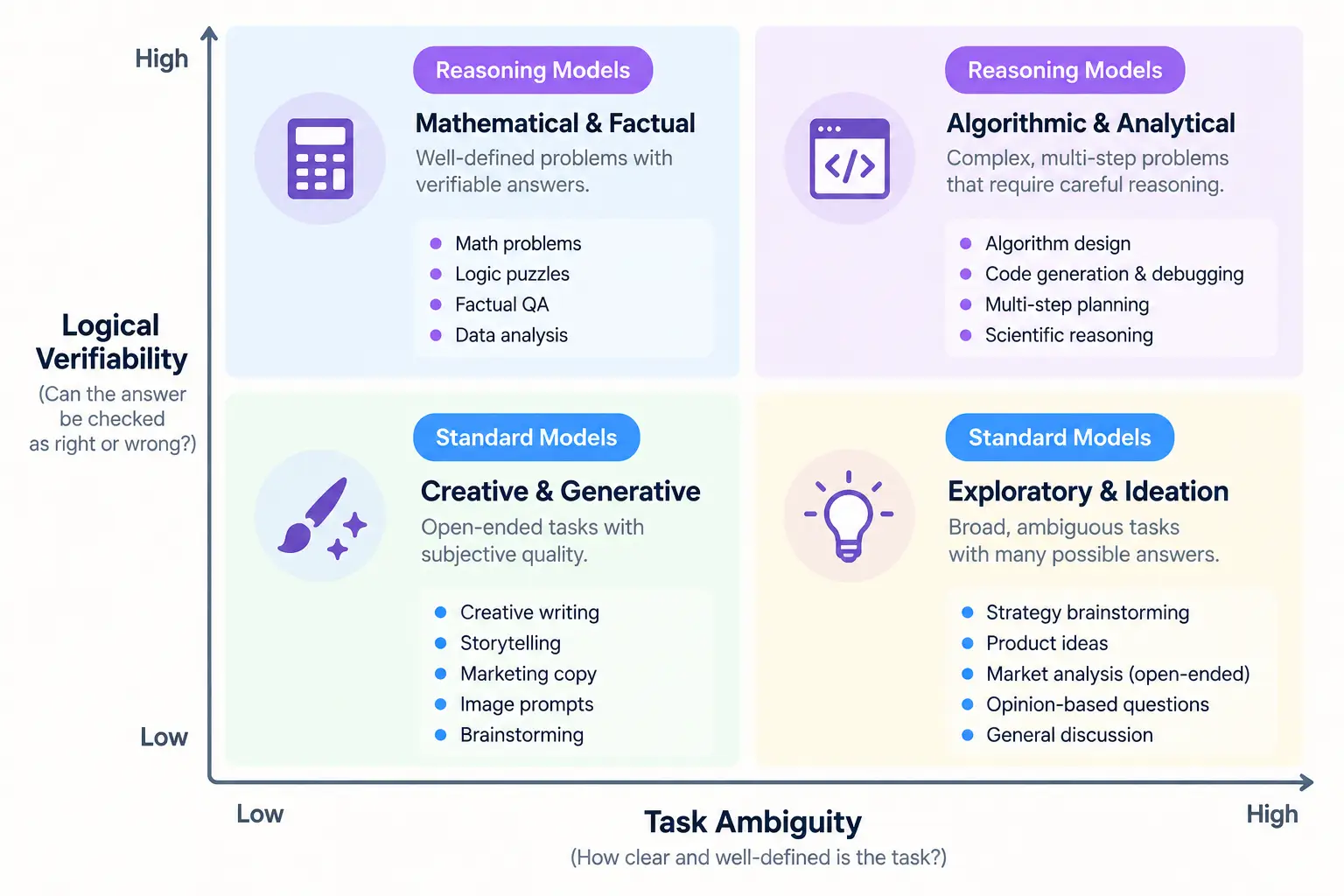
Instead of hunting for one "god-tier" model that handles your entire workday, train yourself to separate logic problems from communication problems.
Does the problem have a mathematically verifiable right answer?
├── YES ──► Use a Dedicated Reasoning Model
└── NO  ──► Does it require recursive planning across 4+ steps?
            ├── YES ──► Use a Dedicated Reasoning Model
            └── NO  ──► Use a Fast Standard Model
When you need deep structural planning, run your initial architecture through a reasoning model first. Then, feed that structured blueprint into a faster, more conversational model to handle the user-facing copy.
Mastering when to switch AI models across a unified workspace is what separates power users from those constantly frustrated by awkward outputs. Instead of cramming complex instructions into a single prompt, why prompt chaining beats one giant prompt becomes clear the moment you assign deduction and drafting to different engines.
Reasoning engines are heavy industrial equipment. You do not drive a bulldozer to pick up groceries just because it has the biggest engine on the lot.
Match the cognitive weight of the model to the true requirements of your task, and you will get answers that are faster, cheaper, and fundamentally more human.
Frequently asked questions
Why do reasoning models take so long to respond to simple prompts?
Do reasoning models cost more per prompt than standard chat models?
Can I force a reasoning model to skip thinking for short tasks?
Which tasks are reasoning models actually best suited for?
We build VirtuaChat and write about getting real work done with AI — prompting, models, images and audio.