
You drop a 45-minute meeting transcript into an AI. You ask for a quick summary.
Five seconds later, you get a clean list of bullet points: "The team discussed project timelines, aligned on strategic priorities, and agreed to follow up next Tuesday."
There is just one glaring problem.
The summary completely missed that your lead architect threatened to delay launch by six weeks, or that your finance lead slashed your marketing budget by a third.
The summary was grammatically flawless, beautifully formatted, and completely useless.
I see this happen across product teams, legal reviews, and executive research every day. We assume that because large language models possess encyclopedic knowledge, summarizing a transcript or whitepaper is child's play.
In reality, plain-vanilla summarization is one of the tasks where default AI behavior fails humans most consistently.
The Trap of Statistical Centrality
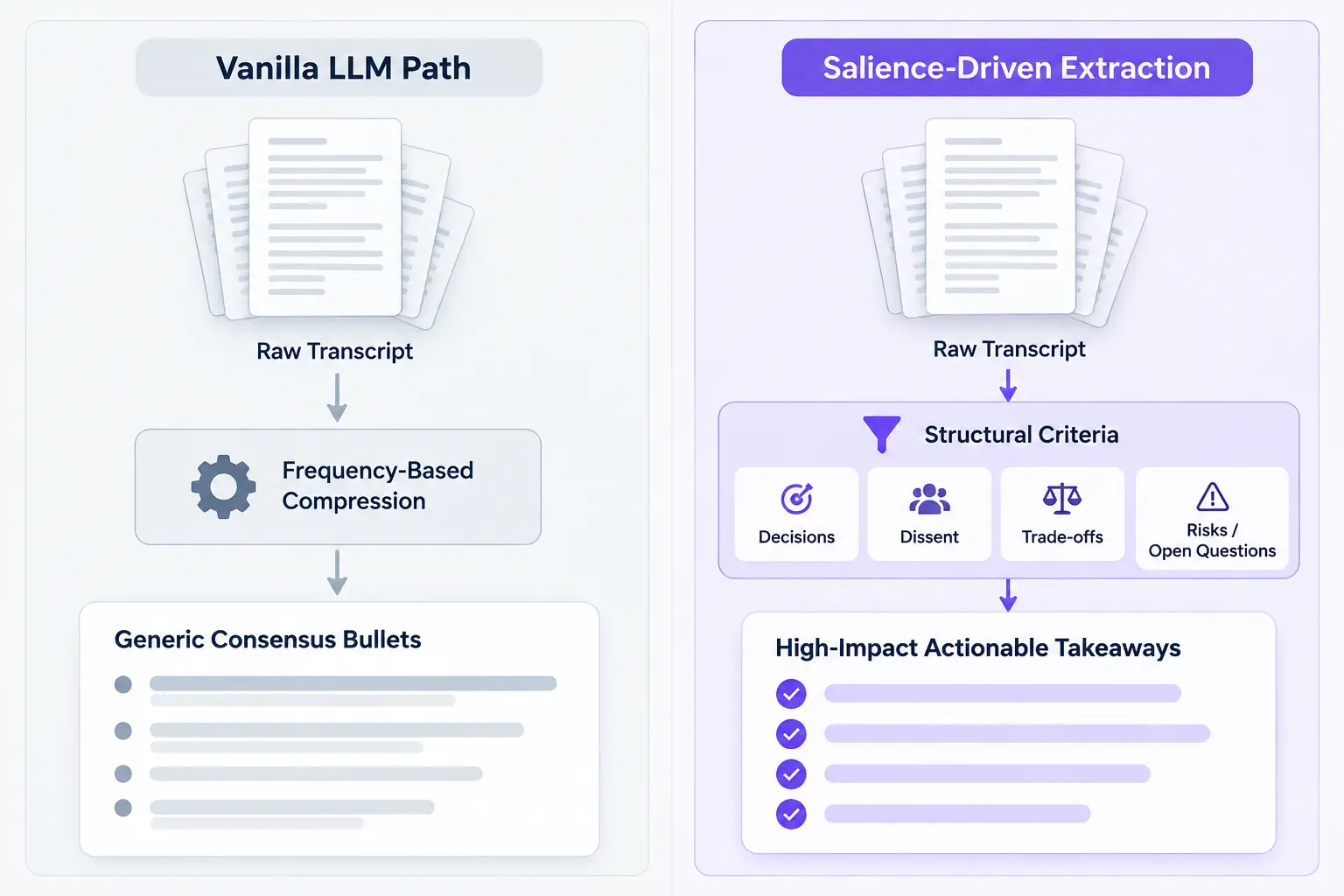
When you tell an AI to summarize a text, it approaches the job through lossy compression.
Language models do not possess human judgment. They do not know what matters to your company's revenue or your project's roadmap unless you explicitly construct the boundary conditions.
Instead, the model calculates probability distributions. It looks for statistical centrality—the concepts repeated most frequently throughout the text.
If your team spent twenty minutes bantering about deployment logistics and two minutes making an urgent, company-altering decision, the model prioritizes the logistics.
This is why your executive summary reads like a sanitized corporate memo instead of revealing the actual blocker.
The model assumes that volume equals value. In human communication, the exact opposite is almost always true.
The Attention Bias Dilemma
Under the hood, modern transformers rely on attention mechanisms to weigh tokens against one another.
While context windows have grown into the hundreds of thousands of tokens, how models allocate attention across that space remains uneven.
Models display heavy recency and primacy biases. They latch onto the opening paragraphs of your uploaded document, glance across the conclusion, and blur the nuanced debates nestled in the middle.
We explored this structural weakness when discussing why AI ignores the middle of your prompts, and the same mechanical issue ravages unstructured documents.
As AI researcher Andrej Karpathy once noted regarding context architectures: "The context window is not a scratchpad; it is an active working memory space where attention degrades as noise accumulates."
When you ask a model to summarize without providing an editorial perspective, it reaches for the safest, most generalized tokens available.
This is why the AI completely ignores the heated argument that happened halfway through your transcript.
 Why AI Summaries Miss the Point (And the Fix)
Why "Summarize This" Fails Every Time
The most common prompt in modern SaaS platforms is also the most flawed:
Summarize the following document into bullet points.
When you write that, you delegate editorial discretion to an algorithm trained on internet-wide consensus. Internet-wide consensus is inherently bland.
The prompt lacks constraints, objective criteria, and negative guidance. It forces the model to guess who the audience is, what constitutes a priority, and what details can be safely abandoned.
| Prompt Approach | How the Model Interprets It | Typical Real-World Result |
|---|---|---|
| Generic Request ("Summarize this") | Compress text based on word frequency | Surface-level bullet points that miss crucial subtext |
| Length Constraint ("Summarize in 3 lines") | Truncate topics indiscriminately | Random selection of primary topics with zero depth |
| Salience Extraction (Role + Dissent + Decisions) | Parse text for state changes and conflicts | Actionable, high-signal brief showing what actually moved |
To get an executive summary that an executive can actually act on, you must stop asking for compression.
You must ask for extraction.
The 3-Step Extraction Architecture
I stopped using the word "summarize" in my prompts six months ago. My outputs immediately improved.
Instead of running a single monolithic prompt, you achieve significantly better accuracy by treating the document like an investigative discovery process.
Rather than relying on one query, using chaining targeted prompts allows the model to process document layers methodically.
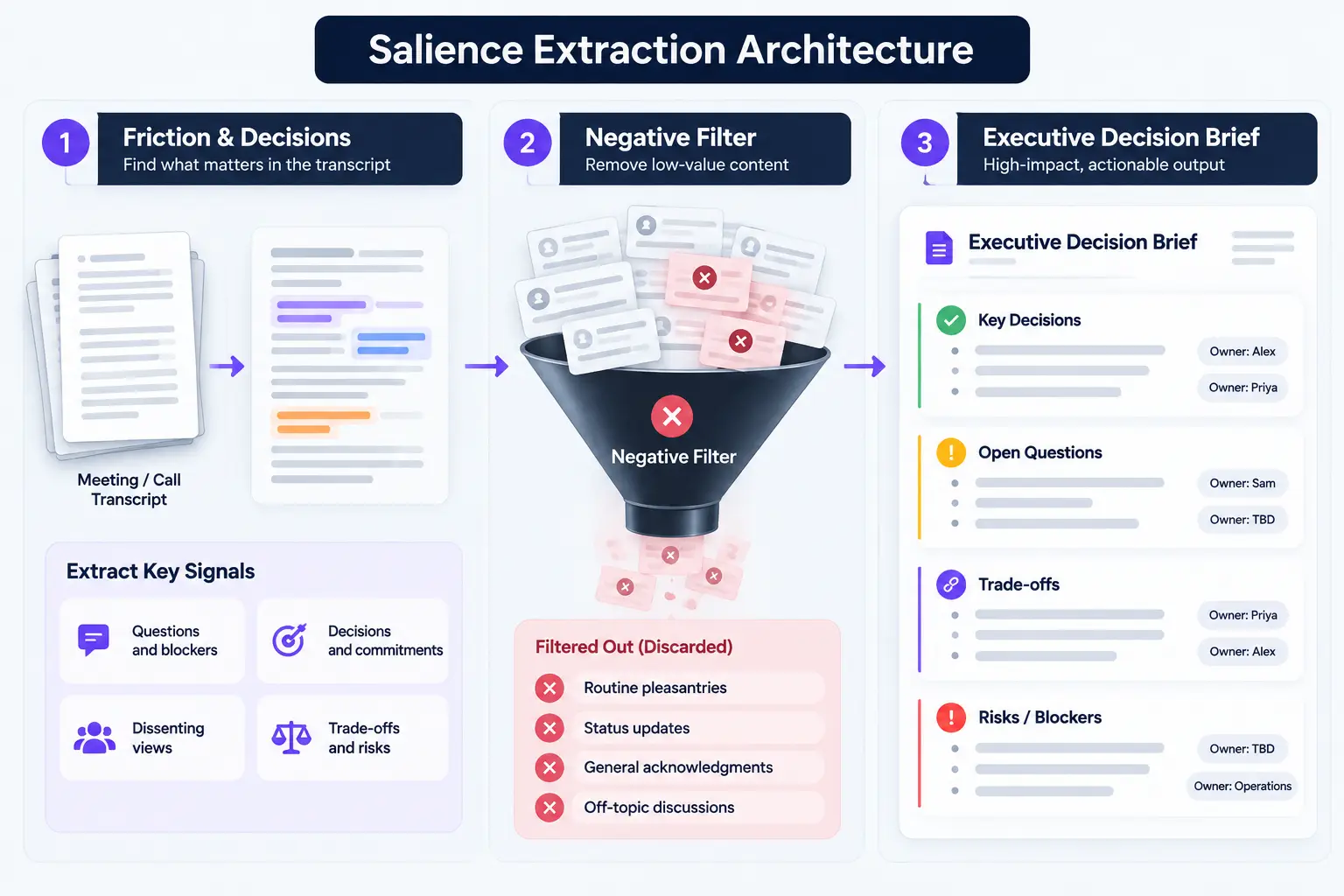
1. Extract Dissent and Decisions First
Before generating a summary, instruct the model to scan solely for inflection points. You want to extract what changed, what was contested, and what remained unresolved.
Here is the exact framework I use for long meetings and client briefs:
Analyze the attached transcript. Do not write a summary yet.
Extract only the following three categories:
1. Hard Decisions Made: Concrete commitments with assigned owners.
2. Unresolved Friction: Debates, pushback, or concerns raised by participants.
3. Explicit Risks: Any timeline, resource, or technical hurdle mentioned.
Quote the specific speakers where relevant.
This forces the attention mechanism to bypass filler talk and zoom straight toward friction.
This is why your teammate's AI summary surfaces the real action items while yours just collects polite bullet points.
2. Force Negative Space Filtering
A critical concept from information theory is that information is measured by how much surprise it contains. Expected pleasantries contain almost zero information.
Explicitly instruct the model on what it must discard:
Exclude all routine project updates, recurring status reports,
and generic alignment phrases. Focus solely on anomalies, budget shifts,
and technical trade-offs.
By defining the negative space, you preserve the model's token budget for high-salience insights.
This is why asking an AI to summarize a legal contract often strips out the exact liability clause you needed to flag, unless you explicitly command it to hunt for risk.
 Why AI Summaries Miss the Point (And the Fix)
3. Synthesis with Forced Tension
Once you have extracted the core data points, run a synthesis step that requires the AI to pit conflicting viewpoints against each other.
Summaries fail when they erase the nuance of disagreement. In business and software architecture, the disagreement is the entire story.
Ask the model to frame the brief around trade-offs:
Using the extracted decisions and risks above, synthesize a 250-word brief.
Format it strictly as:
- The Core Objective
- The Key Trade-Off (What was sacrificed to reach this decision)
- Outstanding Blockers (Who owns the immediate fix)
Designing for Human Intent
When an AI misses the point, it is not being defiant. It is being obedient to statistical averages.
Language models default to the path of least resistance. Left unguided, they smooth over rough edges, reconcile disagreements into polite corporate jargon, and prioritize whichever speaker talked the longest.
If you want summaries that save you hours of reading while keeping you fully informed, you have to guide the filter.
Give the model clear criteria for what matters, forbid generic consensus, and extract friction before you compile conclusions.
The moment you treat summarization as an editorial audit rather than a text shrinker, your AI outputs transform from polite fluff into indispensable intelligence.
Frequently asked questions
Why does AI prioritize polite conversation over critical decisions in meeting transcripts?
Does increasing model context window size fix inaccurate summaries?
What is the difference between text summarization and extraction?
Should I use reasoning models or standard LLMs for document summarization?
We build VirtuaChat and write about getting real work done with AI — prompting, models, images and audio.