
I used to think that telling an AI to "act as a world-class copywriter" was the ultimate hack. It felt like unlocking a secret chamber of hidden expertise.
Every viral guide on social media told me to do it. It seemed logical: give the machine a role, and it will magically inherit that person's decades of deep industry experience.
But after designing workflows and evaluating thousands of model responses, I realized this advice is actively limiting our results.
This is why your teammate's AI output looks better than yours even when you are using the exact same underlying models. You are busy assigning fictional job titles to your AI, while they are focusing on structural boundaries that actually guide the machine.
The Illusion of Role-Playing
When we tell an LLM to adopt a persona, we are engaging in a form of digital role-playing. It feels intuitive because humans use personas to quickly understand social context.
However, large language models do not have an identity, a career history, or professional pride to tap into.
Instead of accessing a "marketing expert" brain, the model looks at the probability of words following your input. It combs through its massive training database to find common patterns associated with that specific label.
This often results in a superficial caricature of the role rather than actual, nuanced expertise.
This is why your AI-generated copy often sounds like an over-enthusiastic late-night TV commercial. It is trying to match the loudest, most common representation of "marketing" in its dataset, which is usually hype and hyperbole.
 Why "Act as a..." Prompts are Ruining Your AI Outputs
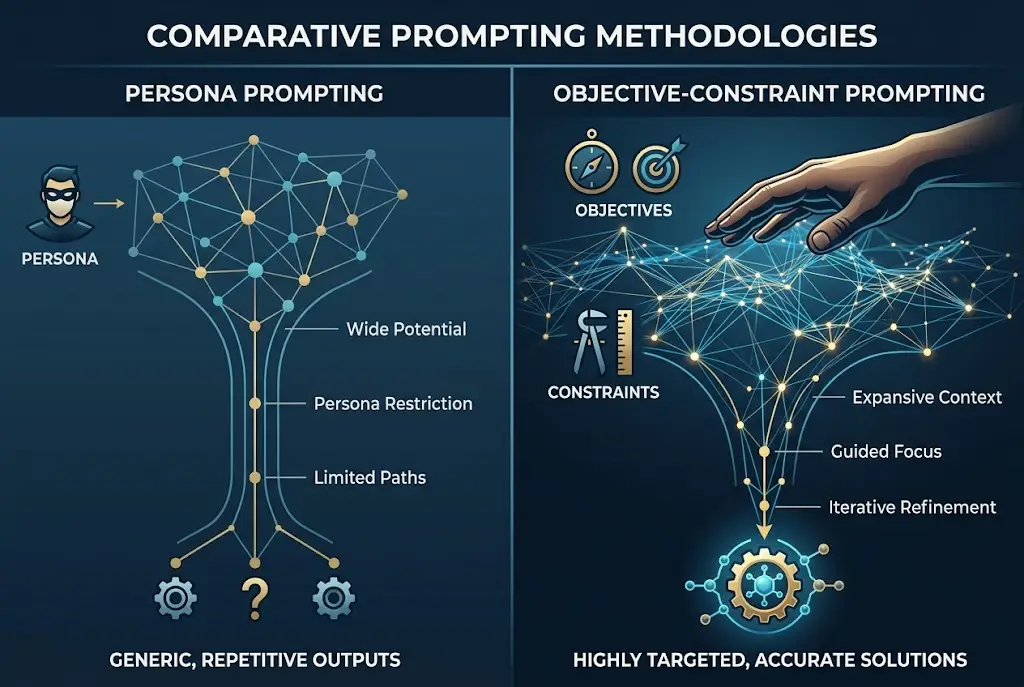
How Personas Constrain the Model
In natural language processing, a persona works as a soft semantic filter. It tells the model to limit its vocabulary and reasoning pathways to a specific subset of its training data.
While this sounds useful, it often cuts off the diverse knowledge bases you actually need.
For example, if you tell a model to "act as a creative writer," it might avoid using structured analytical logic. If you tell it to "act as a programmer," it might struggle to draft conversational, reader-friendly documentation.
You are essentially forcing the model into a narrow corner of its own probability distribution.
This is why switching models mid-conversation or using the wrong model can suddenly break your persona-based prompts. If you've noticed this pattern, you might actually be prompting AI wrong by prioritizing imaginary roles over clear, structured tasks.
The Context, Constraint, and Objective Blueprint
So, what should we do instead of assigning roles? I recommend shifting your focus to a structural framework that defines boundaries rather than identities.
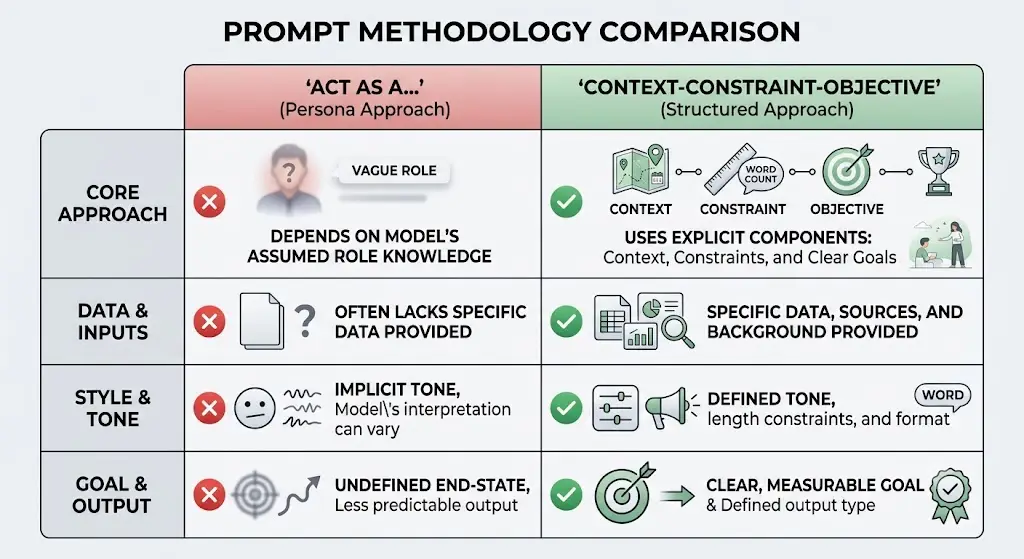
This framework consists of three pillars: Context, Constraint, and Objective.
By separating these elements, you give the model the freedom to use its entire cognitive map while keeping it strictly on track. Here is a simple prompt template to illustrate this transition:
[Context]: We are launching a technical API for mid-level developers who value speed.
[Constraint]: Avoid marketing jargon, do not use exclamation marks, and keep sentences under 15 words.
[Objective]: Explain our rate-limiting policy of 100 requests per minute clearly.
This is why structured prompts produce crisp, professional results, while role-play prompts yield generic essays. You are no longer asking the AI to guess what a "world-class writer" would say; you are telling it exactly what to build.
Defining Your Constraints
Constraints are the secret weapon of prompt engineering. They prevent the model from drifting into generic filler text or making assumptions.
By stating what not to do, you guide the AI far more effectively than by telling it to "be creative."
This is why your draft feels like a machine wrote it; you didn't give the AI boundaries to push against, so it just took the path of least resistance.
 Why "Act as a..." Prompts are Ruining Your AI Outputs
Why Specificity Beats Pretending
We often suffer from a cognitive bias where we assume the AI understands the unwritten rules of a profession. When we say "act as a financial analyst," we assume the AI knows to check for historical inflation patterns.
It doesn't. You must explicitly request those checks.
Let's compare how these two approaches play out in practice:
| Prompt Style | What the AI Thinks | Typical Output |
|---|---|---|
| Persona-based ("Act as an accountant") | "I should use dry language and talk about balance sheets." | A generic overview containing buzzwords and superficial advice. |
| Objective-based ("Identify risks in this ledger") | "I need to look for mathematical discrepancies and missing fields." | A precise, actionable bulleted list of actual ledger anomalies. |
This is why your complex analytical tasks often fall flat when you rely on vague job titles. The AI cannot read between the lines of a professional persona; it requires explicit parameters to perform deep work.
As AI researcher Ethan Mollick notes, "The most effective prompts are those that reduce ambiguity by providing concrete examples and rigid boundaries, rather than relying on stylistic stereotypes."
Overcoming the Persona Trap
To break this habit, you must treat the AI as a highly capable assistant who has no context about your industry.
If you wouldn't give a human colleague a single-sentence instruction like "act as a designer," you shouldn't do it to your AI. Provide the context, the exact references, and the target audience metrics.
This is why your collaborative efforts with AI tools fall short when you assume the model automatically shares your mental model of a specific role.
Building Smarter Workflows
If you are running multi-model workflows, this structural shift is even more critical. Different engines interpret personas in highly divergent ways.
A persona that works beautifully in one model might produce absolute nonsense in another.
When you structure your inputs around constraints and objectives, your prompts become highly portable. You can easily run the same prompt across different models without needing to rewrite everything from scratch.
This becomes incredibly useful when you want to learn when to switch AI models to maximize productivity.
This is why your automation pipelines break down when you rely on artistic or behavioral personas. A structural approach ensures consistency, regardless of which LLM is processing your request.
Making the Shift Today
I challenge you to look at your saved prompts today. Find every instance where you wrote "act as a..." or "you are a..." and delete it.
Replace those lines with two specific constraints and one clear objective.
It might feel strange at first to stop treating the AI like a human colleague. But once you start treating it like a high-powered, logic-driven processing engine, your outputs will transform.
If you're already using AI daily, one workflow change this week could save you hours. Start with the smallest one.
Frequently asked questions
Does removing the persona prompt make the AI sound less professional?
Are there any scenarios where 'Act as...' prompts are actually useful?
How do I translate a complex persona into structured constraints?
Do different AI models respond to constraints differently?
We build VirtuaChat and write about getting real work done with AI — prompting, models, images and audio.