
You spend ten minutes typing a mini-novel into your prompt box.
You lay out your company background, target persona, technical edge cases, and stylistic guidelines. You press send, waiting for magic.
What comes back is a lukewarm, predictable essay that barely scratches the surface of your problem.
I used to repeat this frustrating cycle four or five times a day. Every time an output felt shallow, my instinct was to pile on more background context, more adjectives, and stricter negative constraints.
It felt like the only logical fix. If the model gave me generic garbage, surely it needed more information.
That assumption was wrong.
Dumping massive upfront text causes attention dilution across large language models. Even worse, it forces you to guess what the model needs before it even begins calculating token probabilities.
This is why your AI output feels shallow even after you spent fifteen minutes crafting a 500-word prompt.
The Monologue Trap in Modern Prompting
Most people interact with AI as if they are writing an email to an offshore freelancer who cannot reply.
We treat prompt engineering as a one-way monologue. We assume that if we don't stuff every variable into the initial input, the system will instantly hallucinate or derail.
In cognitive science, this relates directly to cognitive load. When you attempt to unload your entire mental context in one go, you omit implicit assumptions you take for granted.
The AI cannot see your blind spots. Instead, it treats every single word you typed with equal mechanical weight.
If you have ever felt that you've been prompting AI wrong this whole time, this dynamic explains the fatigue. You are doing all the cognitive heavy lifting upfront.
This is why your teammate gets surgical answers with a two-sentence prompt while your three-paragraph essay yields generic corporate fluff.
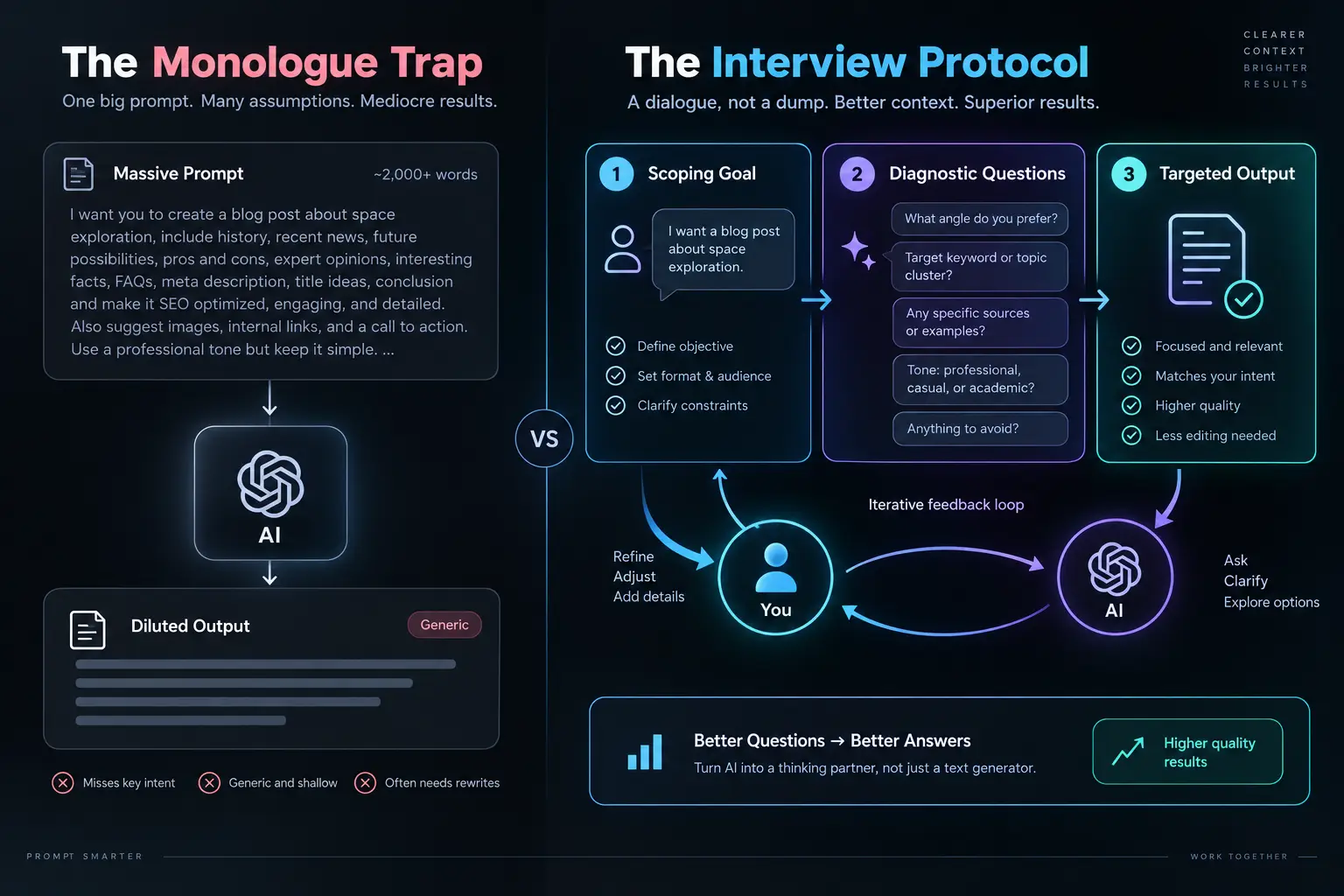 Stop Writing Long Prompts: Make AI Interview You
The Socratic Elicitation Framework
Instead of lecturing the model, flip the dynamic entirely. Turn the AI into an interviewer.
This technique draws from the classic Socratic method, adapted for generative neural networks. In knowledge management, this process is known as knowledge elicitation—extracting tacit requirements through structured inquiry.
As Wharton professor and AI researcher Ethan Mollick observed:
"Don't treat AI as a search engine that you query once; treat it as an eager colleague who needs to ask clarifying questions to do the job right."
When you instruct an AI to interview you, three things happen instantly:
First, the model identifies the precise missing variables it requires to narrow its probability field.
Second, your upfront effort drops from drafting a 400-word prompt to typing two crisp sentences.
Third, you eliminate the cognitive drift that happens when models try to balance twenty competing commands at once.
This is why your AI summaries and briefs miss critical nuances when you try to explain an entire project in a single burst.
The Exact Diagnostic Prompt Template
You do not need complex frameworks to make this work. You just need a prompt that establishes the role, sets the objective, and stops the model from answering prematurely.
Here is the exact master template I use across technical, creative, and strategic projects:
Role: You are an elite [Domain Expert / Product Strategist / Senior Copywriter].
Objective: I need to [insert primary goal, e.g., design a B2B SaaS onboarding flow].

Instructions:
1. Do NOT generate the final deliverable yet.
2. Ask me 3 sharp, diagnostic questions that will give you the essential context, constraints, and target nuances needed for an exceptional result.
3. Wait for my answers before proceeding or asking the next batch.
Notice rule number one. If you do not explicitly forbid the model from generating the deliverable immediately, its default behavior is to answer right away and append questions at the very end.
By forcing a hard pause, you prime the model's working memory specifically around your answers.
This is why your previous attempts at conversational prompting failed: you let the model start writing before it understood your constraints.
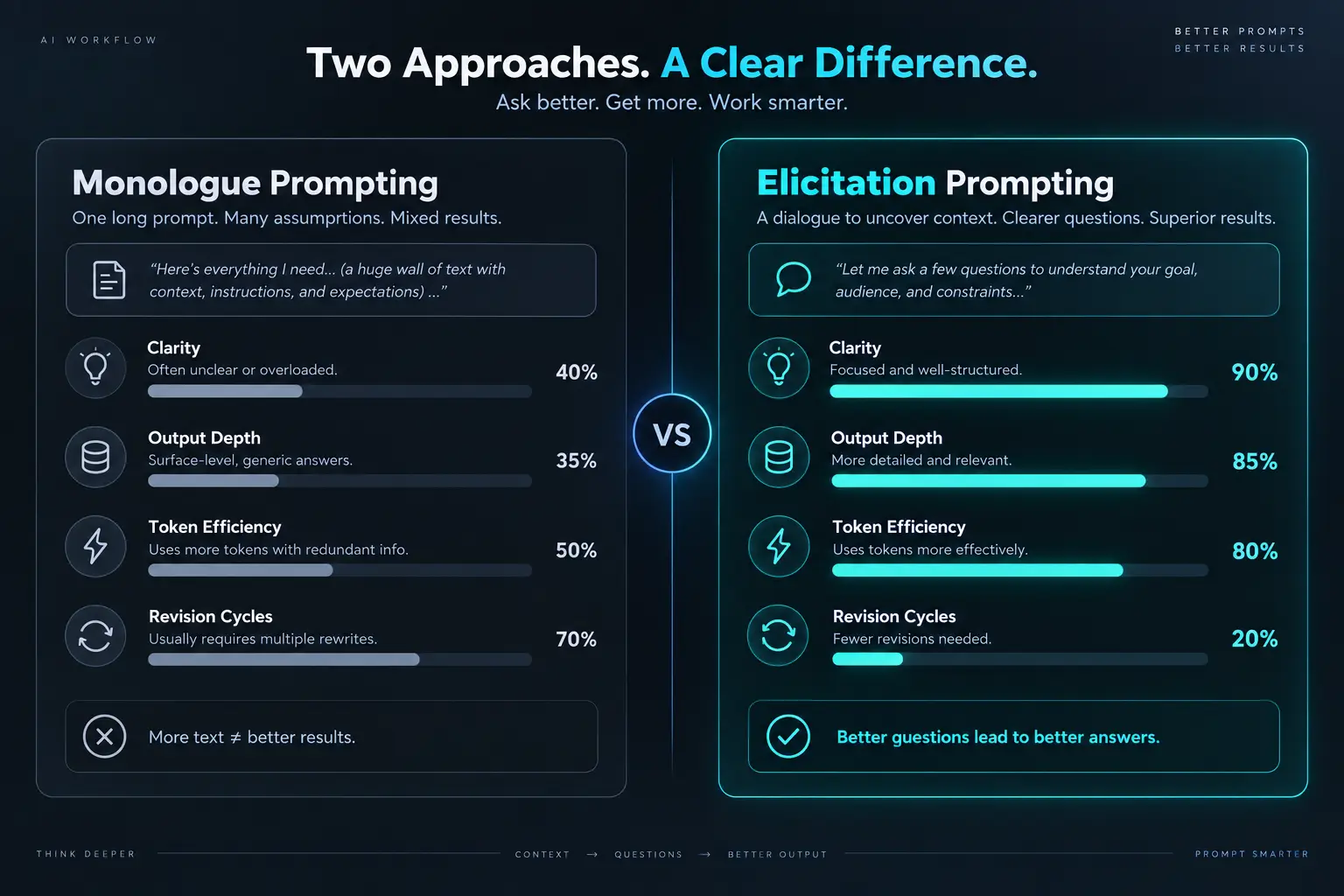
Monologue vs. Interview: A Side-by-Side Comparison
When you compare the two approaches side by side, the difference in efficiency and depth is stark:
| Dimension | The Monologue Approach | The Diagnostic Interview |
|---|---|---|
| Initial Effort | 10–15 minutes drafting context | 30 seconds setting the goal |
| Context Quality | Assumed, cluttered, uneven | Targeted, relevant, precise |
| Output Tone | Generic, safe, boilerplate | Highly tailored, sharp, contextual |
| Revision Cycles | 3–5 frustrating prompt tweaks | 0–1 minor refinements |
| Token Waste | High (stuffed with unneeded backstories) | Low (tokens reserved for core generation) |
When you guide the model through focused Q&A, you also protect yourself against the robotic cadence common in automated writing.
This is why switching to guided elicitation prevents the stiff phrasing discussed in why AI writing sounds robotic.
 Stop Writing Long Prompts: Make AI Interview You
3 Ways to Supercharge the Interview Protocol
Once you start using reverse prompting, you will rarely go back to writing walls of text. Here are three adjustments to make your sessions significantly faster.
1. Enforce Question Batch Limits
Language models love to interrogate you with twelve questions simultaneously if given total freedom.
That defeats the purpose by spiking your cognitive load. Always add: "Ask no more than 2 to 3 questions per reply." This keeps the dialogue fast and iterative.
2. Request Multiple-Choice Options
When dealing with strategic or structural decisions, tell the model: "Provide multiple-choice options (A, B, C) for your questions where appropriate."
Instead of typing paragraphs of explanations, you can simply reply: "1: B, 2: A, 3: Custom constraint..." You give high-signal direction in ten seconds.
3. Ask the Model for Your Own Blindspots
After answering the initial questions, deploy this follow-up:
"Based on my answers, what critical blindspot or unstated assumption am I ignoring in this project?"
You will be stunned by how often frontier reasoning models pinpoint gaps in your pricing, architecture, or distribution logic that you missed entirely.
This is why complex AI roadmaps fall apart halfway through execution: nobody checked for unstated assumptions at the start.
Turning Prompts into Dialogues
The most productive AI practitioners are not the ones typing 2,000-word prompt manifestos into a chat window.
They are the ones who treat the model as a responsive sounding board.
Next time you open a blank chat to tackle a difficult problem, don't exhaust yourself writing an essay. State your goal, hand over the microphone, and let the machine ask the questions.
Frequently asked questions
Which AI models handle the interview protocol best?
Does back-and-forth interviewing consume more tokens than a single prompt?
Can I save this interview prompt as a default custom instruction?
What should I do if the AI asks irrelevant or surface-level questions?
We build VirtuaChat and write about getting real work done with AI — prompting, models, images and audio.